Nobody reading this has not been affected one way or another by cancer; whether you treat patients or conduct research. Or, more personally, if you have a loved one diagnosed or you’ve experienced cancer yourself, then you have more firsthand experience than you care to.
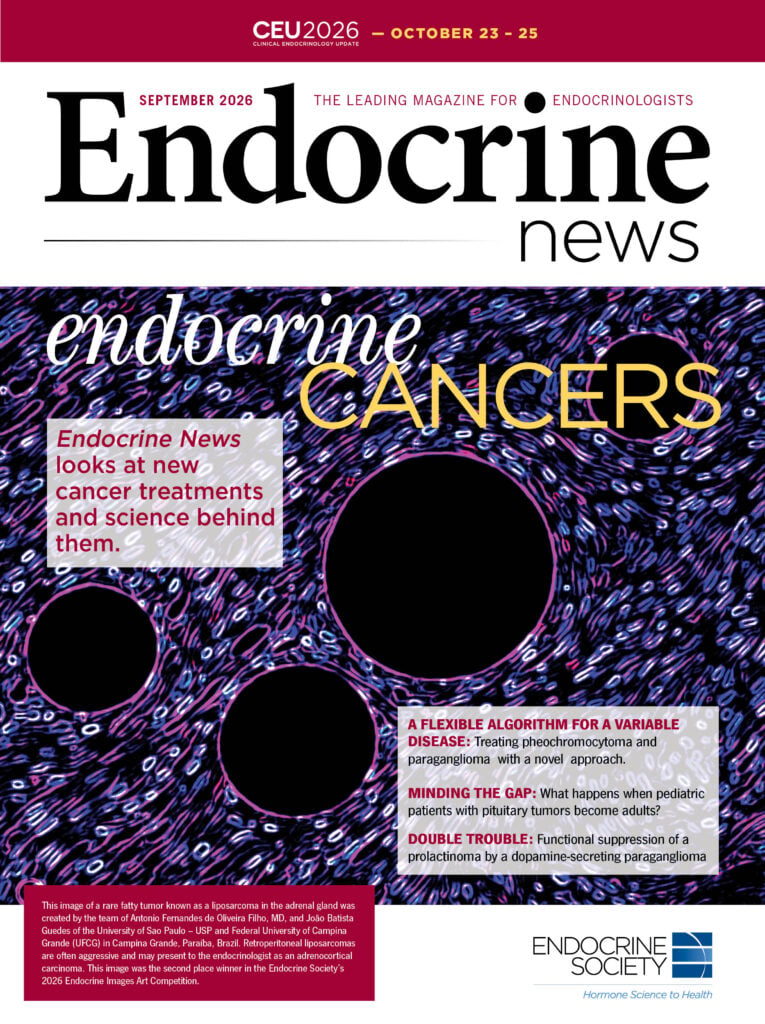
In this month’s issue we are going to focus on a number of endocrine-specific cancers, their treatments, and the solid amount of research that scientists have invested in looking for potential therapies or even cures.
In “A Flexible Algorithm for a Variable Disease,” Kelly Horvath talks with Camilo Jimenez, MD, from the Department of Endocrine Neoplasia and Hormonal Disorders at the University of Texas MD Anderson Cancer Center in Houston about his JCEM paper “Approach to the patient with metastatic pheochromocytoma and paraganglioma: advances in systemic therapy” that focuses on treating a patient with pheochromocytomas and paragangliomas, its complexity, and his team’s algorithm that created a novel approach to guiding treatment decisions. As Kelly writes in the article, the algorithm not only provides a valuable resource since clinical guidelines are absent, but it actually helps to “democratize treatment,” one of the reasons why Jimenez and his team developed it. “The algorithm is a very useful way to guide how to treat patients with pheochromocytoma and paraganglioma,” he explains, “but I have to recognize that in most countries around the world, people won’t easily be able to apply all of it.”
An astounding case of dual cancers was discussed at ENDO 2026 as part of the Clinical Pearls session featuring interesting cases that appeared in JCEM Case Reports. Senior Editor Derek Bagley highlights this case in “Double Trouble: Functional Suppression of a Prolactinoma by a Dopamine-Secreting Paraganglioma,” where he looks at the complexities of treating TWO endocrine cancers in the same patient. “This case is so remarkable because it is the hormonal production from one endocrine neoplasm that is actually very effectively treating a separate and unrelated endocrine neoplasm,” says William F. Young, MD, Msc., editor-in-chief of JCEM Case Reports. “It was only once the dopamine-secreting tumor was resected that it became evident that this patient had a prolactin-producing pituitary adenoma. It is not often that you see this type of endogenous pharmacotherapy!”
When a patient makes the transition from pediatric to adult care, it can be a stressful time for the patient, parents, and the clinician — or clinicians. But imagine making that transition when you’ve been dealing with pediatric pituitary tumors. In “Minding the Gaps: What Happens When Pediatric Patients with Pituitary Tumors Become Adults?,” Kelly speaks to Kevin C. J. Yuen, MD, FRCP, FEAA, about his ENDO 2026 Meet the Professor session titled “Pituitary Tumor Survivorship: Transitioning from Pediatric to Adult Endocrine Care” in which he detailed the often-complicated shift for these patients and their clinicians. Challenging though it can be, he says guidance is available, but it is vital for patients, parents, and clinicians to start early.
We change gears somewhat as Glenda Fauntleroy Shaw talks to the Endocrine Society’s 2026 Outstanding Educator Laureate Award recipient, Bradley David Anawalt, MD, in “Sharing the Joy, Excitement, and Enthusiasm.” Honored for both his contributions to education and andrology, Anawalt discusses how he tailors his teaching techniques based on the types of students he is talking to at the time. According to Anawalt, he never says no to a teaching opportunity, and that taught him how to tailor his messages. “What I learned was that you don’t approach a talk given to students the same way you do when you give a talk on the same topic to residents, fellows, or faculty members,” he explains. “Not only is their content knowledge different and their level of learning, but what they want out of a talk is totally different. I have to completely reorient, and that means that I have to learn something about the learners. Adapting what I teach to different audiences and seeing what they take away from my lectures has been fascinating.”
Feel free to reach out to me and let me know what you think of this issue and what you’d like to see in future issues. Remember, Endocrine News is YOUR magazine, so your input is vital. You can reach me at: [email protected].