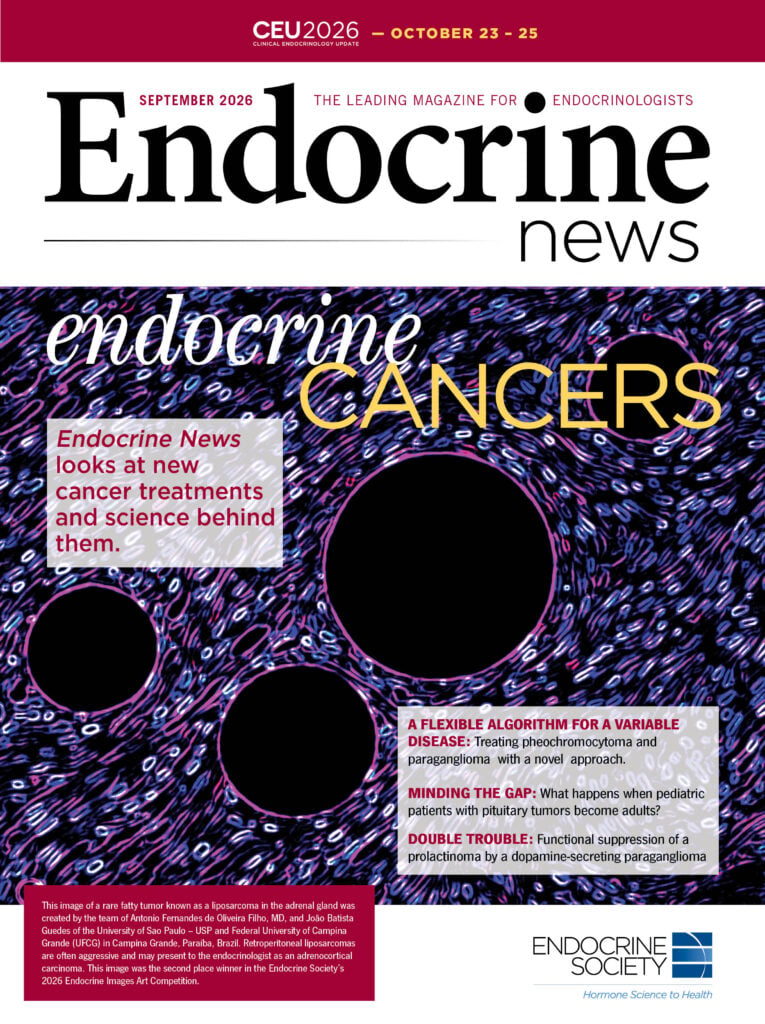
Double Trouble: Functional Suppression of a Prolactinoma by a Dopamine-Secreting Paraganglioma
By Derek Bagley
A recent JCEM Case Reports article describes a 52-year-old male who presented with cerebrospinal fluid rhinorrhea and was found to have an invasive, 4.2-cm pituitary mass with modestly elevated prolactin. When the surgeons resected the tumor, it revealed another. Two rare endocrine tumors occurring recurrently. Endocrine News speaks with the lead author, who shared the findings at ENDO 2026 in Chicago.
This is a good one, what endocrinology is all about: true detectives. In April 2025, JCEM Case Reports published an article titled, “Functional Suppression of a Prolactinoma by a Dopamine-Secreting Paraganglioma,” describing the case of a 52-year-old male who presented with cerebrospinal fluid rhinorrhea and was found to have an invasive, 4.2-cm pituitary mass with modestly elevated prolactin. “Additional imaging discovered a mediastinal mass suspicious for a thoracic paragangliom,” the authors write. “Biochemical screening demonstrated marked elevation of plasma and urinary dopamine.”
This past summer, lead author Tamaryn Fox, MD, a clinical fellow in training to Cedars Sinai Medical Center in Los Angeles presented the findings at ENDO 2026 in Chicago.
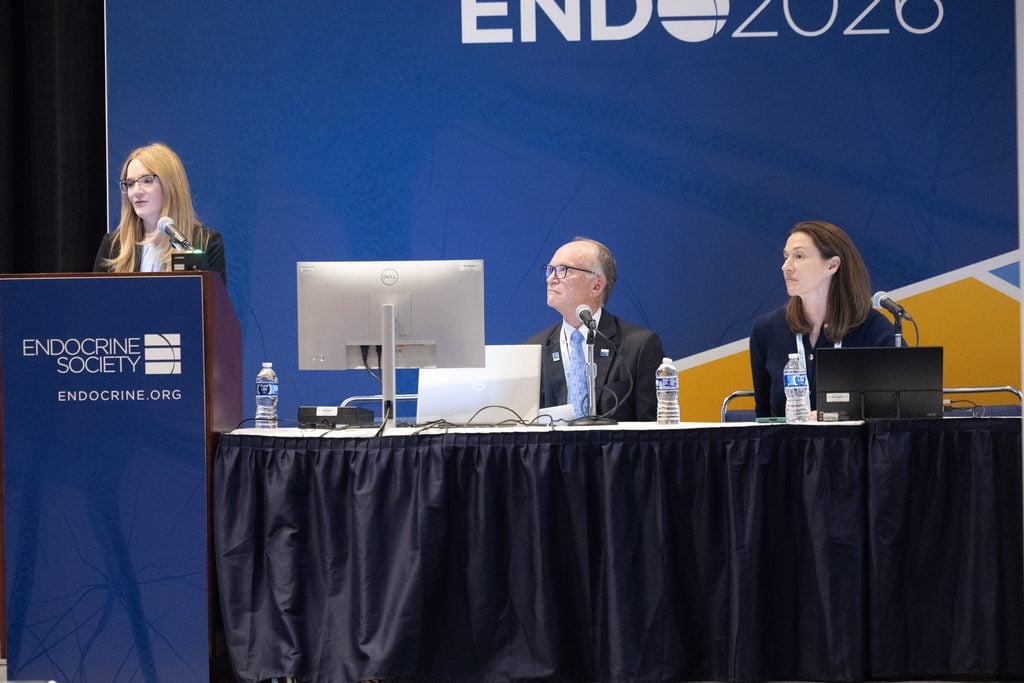
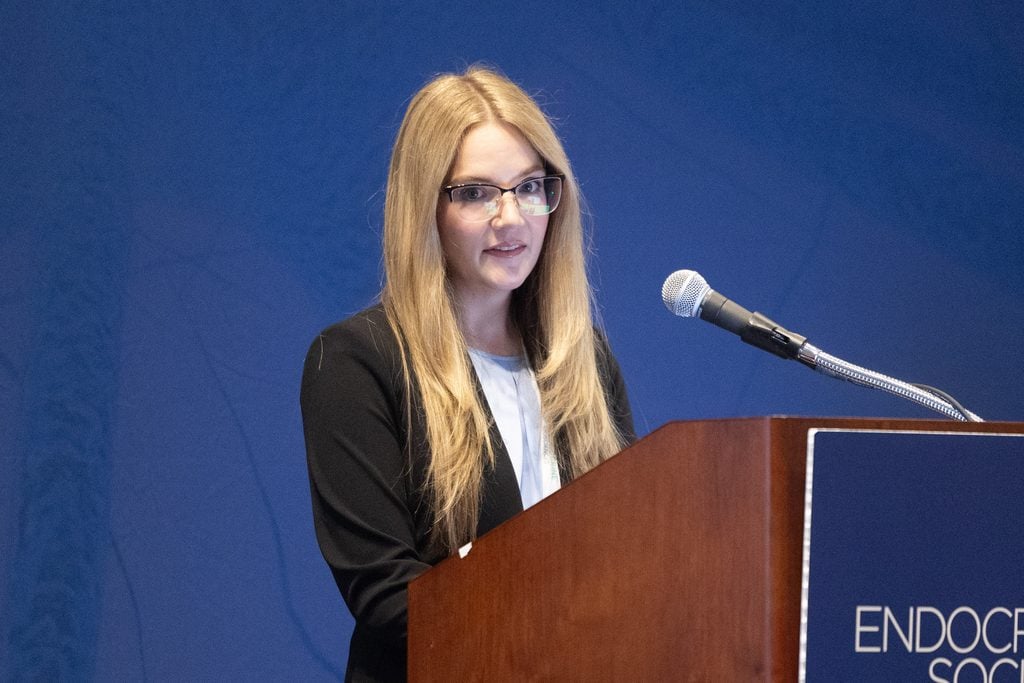
Tamryn Fox, MD, at the podium during ENDO 2026 session, “Clinical Pearls from JCEM Case Reports” as William F. Young, Jr. MD, and Sarah Mayson, MD, look on.
“This case is so remarkable because it is the hormonal production from one endocrine neoplasm that is actually very effectively treating a separate and unrelated endocrine neoplasm,” says William F. Young, MD, Msc, the Tyson Family Endocrinology Clinical Professor and professor of medicine in the Mayo Clinic College of Medicine at Mayo Clinic in Rochester, Minn., and editor-in-chief of JCEM Case Reports. “It was only once the dopamine-secreting tumor was resected that it became evident that this patient had a prolactin-producing pituitary adenoma. It is not often that you see this type of endogenous pharmacotherapy!”
Double Whammy
Fox tells Endocrine News that the patient had initially been told about the tumors before he had established care with Fox and her colleagues, but she says it was certainly unexpected. “Not only did he have two rare endocrine tumors occurring concurrently, but they appeared to be hormonally interacting with one another, which was particularly fascinating,” she says.
The authors write that they report a novel biologic signaling mechanism between two rare primary endocrine tumors and highlight challenges in their diagnosis and management.
“One of the most striking features was that we knew he had two tumors, but it was only after removal of the dopamine-secreting paraganglioma that his prolactin rose significantly, suggesting that the two tumors were interacting hormonally,” Fox says. “The dopamine produced by the paraganglioma was likely suppressing prolactin secretion from the prolactinoma.”
The JCEM Case Reports authors lay it out like this: Prolactin-secreting pituitary adenomas are typically treated with dopamine agonists to inhibit prolactin secretion and reduce tumor size. Dopamine-secreting paragangliomas are rare neuroendocrine tumors of sympathetic and parasympathetic paraganglia and often do not provoke symptoms of catecholamine excess. “Although overlapping genetic drivers have been described for paragangliomas and pituitary adenomas, biochemical crosstalk between coexisting tumors is underexplored,” they write.
“Having these two rare endocrine tumors occur together is highly unusual, and in this patient, their interaction provided a fascinating window into the physiologic relationship between endogenous dopamine and prolactin. The case also highlights that dopamine-secreting paragangliomas may be clinically subtle and underscores the importance of genetic evaluation in patients with pheochromocytoma or paraganglioma, as well as in patients with multiple endocrine tumors.” – Tamaryn Fox, MD, clinical fellow in training, Cedars Sinai Medical Center, Los Angeles, Calif.
The case also highlights that dopamine-secreting paragangliomas can be underrecognized because patients may have few or no symptoms, Fox explains. On immunohistochemical staining, the pituitary tumor was PIT-1 positive but negative for the expected lineage hormones, including prolactin, despite its clinical diagnosis as a prolactinoma. “We felt this was most consistent with an immature PIT-1-lineage pituitary adenoma, a rare tumor type that can be less differentiated, larger, and more aggressive, with variable hormone staining and secretion,” she says. “This variability may help explain the discordance between the clinical diagnosis and the tumor’s immunohistochemical findings.”
In the Genes
The JCEM Case Report also remarked on genetic testing on the patient, writing that the process had revealed previously unreported germline SDHC variant of uncertain significance.
“Genetic testing is important for all patients with pheochromocytoma or paraganglioma, regardless of whether additional endocrine tumors are present,” Fox says. “In our patient, the presence of multiple endocrine tumors made the possibility of an underlying hereditary syndrome particularly relevant. His testing identified an SDHC variant of uncertain significance (VUS), which did not provide a definitive genetic diagnosis in his case. In general, when a pathogenic variant is identified, it can have important implications for the patient’s long-term surveillance and for at-risk family members.”
Learning from Unusual Cases
The patient’s initial prolactin level prior to paraganglioma resection was much lower than expected for a typical prolactinoma of this size, which raised suspicion for a poorly functional or less well-differentiated prolactinoma or other nonfunctional sellar mass, the authors write in the Discussion section “However, the subsequent six-fold rise of prolactin [two] weeks following paraganglioma surgery indicated that endogenous dopamine secretion from the paraganglioma exerted tonic inhibition on prolactin secretion from the pituitary adenoma,” they continue. “Removal of the paraganglioma unmasked prolactin hypersecretion.”
As of now, the patient is asymptomatic and elected to continue treatment with cabergoline, denying radiation treatment, but to maintain prolactin suppression and to shrink the tumor, the authors note.
“I think the main takeaway is how much we can learn from an unusual case like this,” Fox says. “Having these two rare endocrine tumors occur together is highly unusual, and in this patient, their interaction provided a fascinating window into the physiologic relationship between endogenous dopamine and prolactin. The case also highlights that dopamine-secreting paragangliomas may be clinically subtle and underscores the importance of genetic evaluation in patients with pheochromocytoma or paraganglioma, as well as in patients with multiple endocrine tumors.”
Sharing the News
Fox says this case was incredibly interesting and that she was happy to share it at ENDO 2026.
“I had an incredible experience at ENDO in Chicago,” she says, “It was an honor to be invited by Drs. Young and Mayson to present this case during the ‘Clinical Pearls from JCEM Case Reports’ symposium. They are both people I greatly admire, so it was especially meaningful to be part of that session. I’m also very grateful to Dr. [Lauren] Fishbein for her thoughtful insights and pearls on the case.
“This case is so remarkable because it is the hormonal production from one endocrine neoplasm that is actually very effectively treating a separate and unrelated endocrine neoplasm,” says “It was only once the dopamine-secreting tumor was resected that it became evident that this patient had a prolactin-producing pituitary adenoma. It is not often that you see this type of endogenous pharmacotherapy!” – William F. Young, MD, Msc, Tyson Family Endocrinology Clinical Professor; professor of medicine, Mayo Clinic College of Medicine, Mayo Clinic, Rochester, Minn.; editor-in-chief, JCEM Case Reports
“As a fellow, I was fortunate to have tremendous support from my colleagues and mentors at Stanford Endocrinology. I learned a lot, enjoyed sharing the case, and even found some time to play with puppies! ENDO is always a highlight of the year.”
Bagley is the senior editor of Endocrine News. In the August issue, he wrote the ENDO 2026 wrap up, “ENDO 2026: Progress and Resilience.”
Join the Global Movement Advancing Endocrine Science and Medicine
Become a part of a community of 18,000-plus endocrine investigators and clinicians who conduct research and provide quality patient care in more than 100 countries. Advance your career and the field of endocrinology through our many educational, leadership and advocacy opportunities.