
If it’s July, then it must be Endocrine News’ annual Early-Career issue time once again. This is one of my favorite issues we do because it gives us the chance to highlight so many of our up-and-coming members who are making strides in research and clinical practice as they begin their lives as endocrinologists.
In “The Family Business: A Father and Son Who Share More than a Name” by Kelly Horvath, endocrinology is very much “like father, like son” for the Dumesics: Phillip Dumesic, MD, PhD, whose lab studies gene expression at the University of California – San Francisco, followed his father, Dan Dumesic, MD, an expert in PCOS (now PMOS) at UCLA, into the field. They each discuss their research, dad’s influence on son, and how their work actually converges at the adipocyte: “In terms of the common denominator between our work, the genes, the physiology, the basic science that drives fat metabolism, stem cell differentiation to muscle cells versus fat cells, and their function — these are all molecular tools that Phillip is now working with,” Dan explains. “Not only is he involved with metabolism, but as he mentioned, also sarcopenia and muscle physiology.”
Senior Editor Derek Bagley talks to this year’s Bardin Award winner Rok Herman, MD, in “Game Changer” who discusses his outstanding ENDO 2026 abstract showing tirzepatide doesn’t just help people lose weight; it also activates brown adipose tissue, which could be a watershed moment in obesity research. “This adds a new layer to how we understand the new generation of anti-obesity medications,” Herman says. “They are not only appetite suppressants — tirzepatide also appears to modulate energy expenditure at the tissue level, opening a plausible path toward future therapies that combine appetite regulation with thermogenic activation.” No doubt we’ll be hearing more about Herman’s research in upcoming issues!
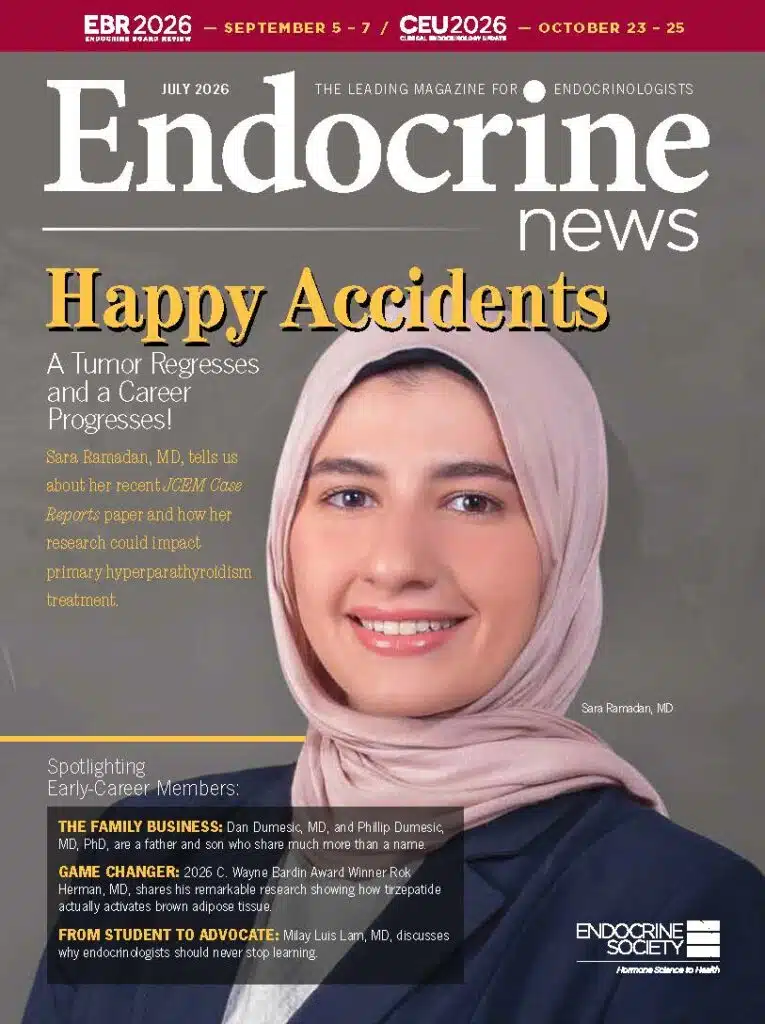
In “Happy Accidents: A Tumor Regresses and a Career Takes Off,” Kelly speaks with Early-Career member Sara Ramadan, MD, who discusses her study “Unanticipated remission of primary hyperparathyroidism following cinacalcet,” that was published in JCEM Case Reports in March. Aside from talking about what her research could mean for the future treatment of PHPT, Ramadan also tells us how joining the Endocrine Society has impacted her career and her research. “When I initially joined during my first year of residency, I was still finding my voice and figuring out which direction in endocrinology I was heading,” she says. “Getting access to people who are further along, not just for mentorship in the traditional sense, but to see how they build their careers and define their niches, has been really valuable.”
Inspired by a recent EXCEL meeting this spring at the Endocrine Society offices in Washington, D.C., Early-Career member Milay Luis Lam, MD, shares her thoughts on why it is so important for endocrinologists to maintain their humanity in “The Human Side of Endocrinology: From Learner to Advocate.” “Patients sometimes see physicians as belonging to another world — detached, distant, almost ‘less human,’” she says. “At the same time, physicians can fall into the trap of viewing patients through a purely clinical lens, reducing complex lives into diagnoses. This quiet dehumanization can go both ways, shaped by expectations, past experiences, and systemic pressures.”
Next month will be a wrap up of ENDO 2026 in Chicago, Ill., June 13 – 16. Be sure to check out what you might have missed or relive some wonderful memories! Also, fee free to drop me a line at [email protected] to share your thoughts on our new website as well as any story ideas you might have for the future.