Game Changer: 2026 Bardin Award Winner Rok Herman, MD
By Derek Bagley
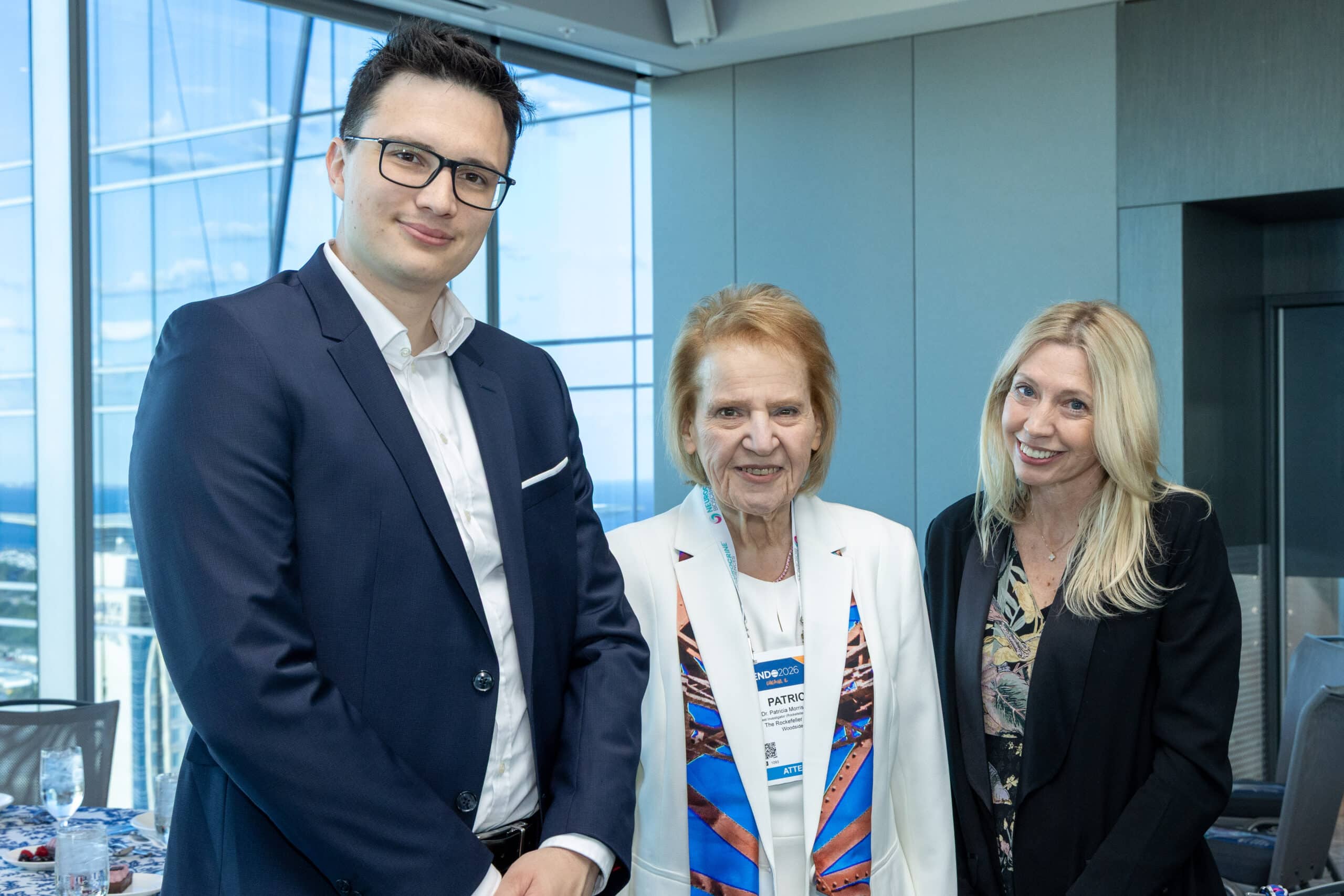
Rok Herman, MD, (above, with Patricia Morris, PhD (center), and Mojca Jensterle, MD, PhD, one of Herman’s mentors, at the Excellence in Endocrinology Dinner that took place during ENDO 2026 in Chicago, Ill.) speaks to Endocrine News after taking home the 2026 C. Wayne Bardin, MD, International Travel Award for his outstanding ENDO 2026 abstract showing tirzepatide doesn’t just help people lose weight; it also activates brown adipose tissue, which could be a watershed moment in obesity research.
Rok Herman, MD, always knew that he wanted to specialize in one of the fields of internal medicine, but his path to endocrinology became clear when he was a medical student, when his mentors involved him early in the research team of his department.
“Through that experience, I quickly fell in love with research,” Herman says. “It did not take long before my goal became not only to research and practice endocrinology, but to master it in a way that would allow me to best help my patients. This field offers a rare combination of precise physiology, complex clinical reasoning, and direct therapeutic impact.”
The Endocrine Society awarded Herman the 2026 C. Bardin, MD, International Travel Award, which honors an outstanding ENDO abstract submitted by an international endocrine fellow or junior faculty member.
Herman is a medical doctor and internal medicine resident at the Department of Endocrinology, Diabetes and Metabolic Diseases at the University Medical Centre Ljubljana in Slovenia. His academic and research work has already been recognized with multiple domestic awards in medicine, alongside a publication record that is notable for this early stage of his career.
“Receiving this award is a tremendous honor,” Herman says. “As an early-career physician-scientist, I had an idea a few years ago and then spent countless days and nights trying to bring it to life. This recognition makes the long nights, setbacks, and doubts feel worth it.
“Over the last few years, I have become increasingly interested in brown adipose tissue research, and our team will continue studying how we can improve its measurement in humans, what mechanisms drive its proposed systemic metabolic benefits, and which interventions could activate it in clinical practice.” – Rok Herman, MD, internal medicine resident, Department of Endocrinology, Diabetes, and Metabolic Diseases, University Medical Centre, Ljubljana, Slovenia
Herman goes on to says that when he received the news, he felt deeply grateful — to the whole team, especially his mentors and professional role models, Prof. Andrej Janež and Prof. Mojca Jensterle.
“And to my wonderful family, whose support made this journey possible,” Herman says. “Together, they helped me turn a technically demanding clinical research idea into a completed randomized trial. The award feels especially meaningful because Prof. Bardin’s career reflects the path of someone trying to excel as a physician, push research forward, and be present for one’s family all at once. That is something I have been trying to build in my own life, and seeing such an example in one of the giants of endocrinology feels like a quiet form of mentorship across time.”
Major Milestone in Obesity Research
For his ENDO 2026 presentation, Herman shared results from the TABFAT (Tirzepatide Brown and Beige Adipose Tissue Activation) trial, which found that tirzepatide doesn’t just help people lose weight; it also activates brown adipose tissue, representing a major milestone in obesity research.
“In the TABFAT trial, we asked a different question: Beyond eating less, does tirzepatide also change how the body burns energy — specifically through brown adipose tissue, a metabolically active type of fat that produces heat and consumes calories?” Herman says.
In a randomized, placebo-controlled clinical trial in premenopausal women with obesity, Herman and colleagues used cold-stimulated PET/CT imaging, MRI scans and infrared thermography to measure brown adipose tissue activity before and after 24 weeks of treatment.
“We found that tirzepatide significantly increased brown adipose tissue activity and volume, and we are also exploring signs of converting white subcutaneous fat into more metabolically active ‘beige’ fat,” Herman says.
The proportion of participants with PET/CT-detectable brown adipose tissue increased from 41.2% to 64.7% in the tirzepatide group, while no comparable change was observed in the placebo group. In addition, volume and activity of cold-stimulated brown adipose tissue increased in the tirzepatide treated participants. “We were also encouraged by the consistency of the signal across other imaging modalities employed in the study that may capture different components of brown fat biology,” Herman adds.
“This adds a new layer to how we understand the new generation of anti-obesity medications,” Herman says. “They are not only appetite suppressants — tirzepatide also appears to modulate energy expenditure at the tissue level, opening a plausible path toward future therapies that combine appetite regulation with thermogenic activation.”
Herman suggests that future research measures, studies, and potentially enhances the use of brown and beige fat activity as a specific target for a tailored approach to obesity care.
“I am currently finishing the data analysis for the TABFAT trial and plan to publish main results later this year,” Herman tells Endocrine News. “One of the most exciting parts for me now is moving beyond imaging and clinical outcomes into deeper analyses of adipose tissue biopsies, and I am eagerly awaiting the first results in the coming weeks. Over the last few years, I have become increasingly interested in brown adipose tissue research, and our team will continue studying how we can improve its measurement in humans, what mechanisms drive its proposed systemic metabolic benefits, and which interventions could activate it in clinical practice.”
“The award feels especially meaningful because Prof. Bardin’s career reflects the path of someone trying to excel as a physician, push research forward, and be present for one’s family all at once. That is something I have been trying to build in my own life, and seeing such an example in one of the giants of endocrinology feels like a quiet form of mentorship across time.” – Rok Herman, MD, internal medicine resident, Department of Endocrinology, Diabetes, and Metabolic Diseases, University Medical Centre, Ljubljana, Slovenia
At the same time, the team in Ljubljana continues working in the broader obesity field, currently especially on the effects of obesity pharmacotherapy on skeletal muscle status, where they hope to present detailed results by this time next year. Herman says that he’s also involved in several other projects, ranging from endocrine mechanisms in postural orthostatic tachycardia syndrome to bone-metabolic interactions in polyendocrine metabolic ovarian syndrome, bone health in indolent systemic mastocytosis, and endocrine adaptations to fasting, to name a few. “There is a lot in the pipeline, but scientifically this is exactly the kind of dynamic period I hoped to be part of,” he says.
Strong Researcher = Better Physician
Herman says that what inspires him most is that, despite all the challenges of being both a clinician and a researcher, he still able to spend most of his time with patients. “I quickly learned that becoming a strong researcher also makes you a better physician and seeing someone you care for get better remains the most satisfying part of my job,” he says. “I have also been fortunate to connect with passionate people at our center — physicians, researchers, nurses, administrators, many of whom have become good friends. We can spend hours discussing ideas, difficult cases, and research questions outside of work and still not feel like we are really working. That environment keeps my mind in a mode where new ideas almost never stop coming and knowing that some of those ideas can eventually become real discoveries, as happened with TABFAT, makes the whole process feel meaningful beyond the day-to-day.”
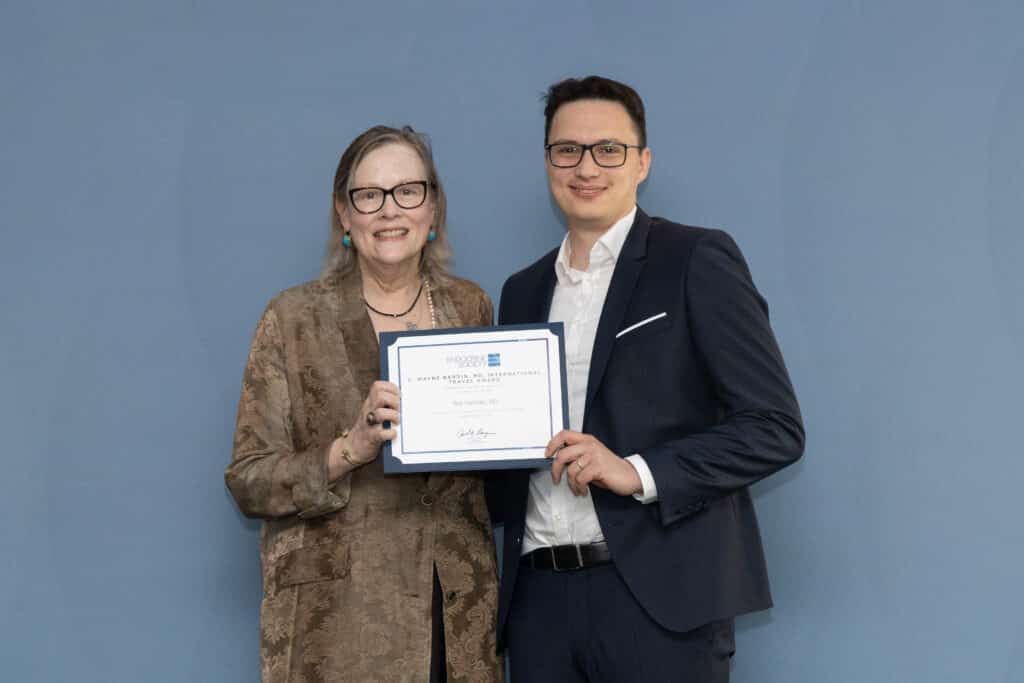
Rok Herman, MD, with Endocrine Society President Carol Lange, PhD, at the Excellence in Endocrinology Dinner that took place during ENDO 2026 in Chicago, Ill.
Herman says that personally, the award is a major encouragement and tells him that the scientific question his team is pursuing is relevant, that their approach is of interest to the international endocrine community, and that their results can stand alongside work from leading centers around the world. “That is extremely motivating at this stage of my career,” he says, “For our institution, it is also an important recognition. The University Medical Centre Ljubljana and our Department of Endocrinology have strong clinical expertise and a growing research environment. This award helps show that high-quality, mechanistic clinical research can be carried out in Slovenia, and it strengthens our ability to build international collaborations.”
Herman goes on to sing the praises of the Endocrine Society as an important window into the international endocrine community. “Its meetings, publications, and educational activities help define the scientific and clinical standards of the field,” he says. “For someone early in an academic career, that exposure is invaluable. Presenting our work at ENDO is therefore not only a personal milestone, but also an opportunity to connect our research with a much broader community of clinicians and scientists.”
Bagley is the senior editor of Endocrine News. In the June issue, he wrote about the Endocrine Society’s central precocious puberty guideline that was released last month at ENDO 2026 in Chicago, Ill.
Join the Global Movement Advancing Endocrine Science and Medicine
Become a part of a community of 18,000-plus endocrine investigators and clinicians who conduct research and provide quality patient care in more than 100 countries. Advance your career and the field of endocrinology through our many educational, leadership and advocacy opportunities.