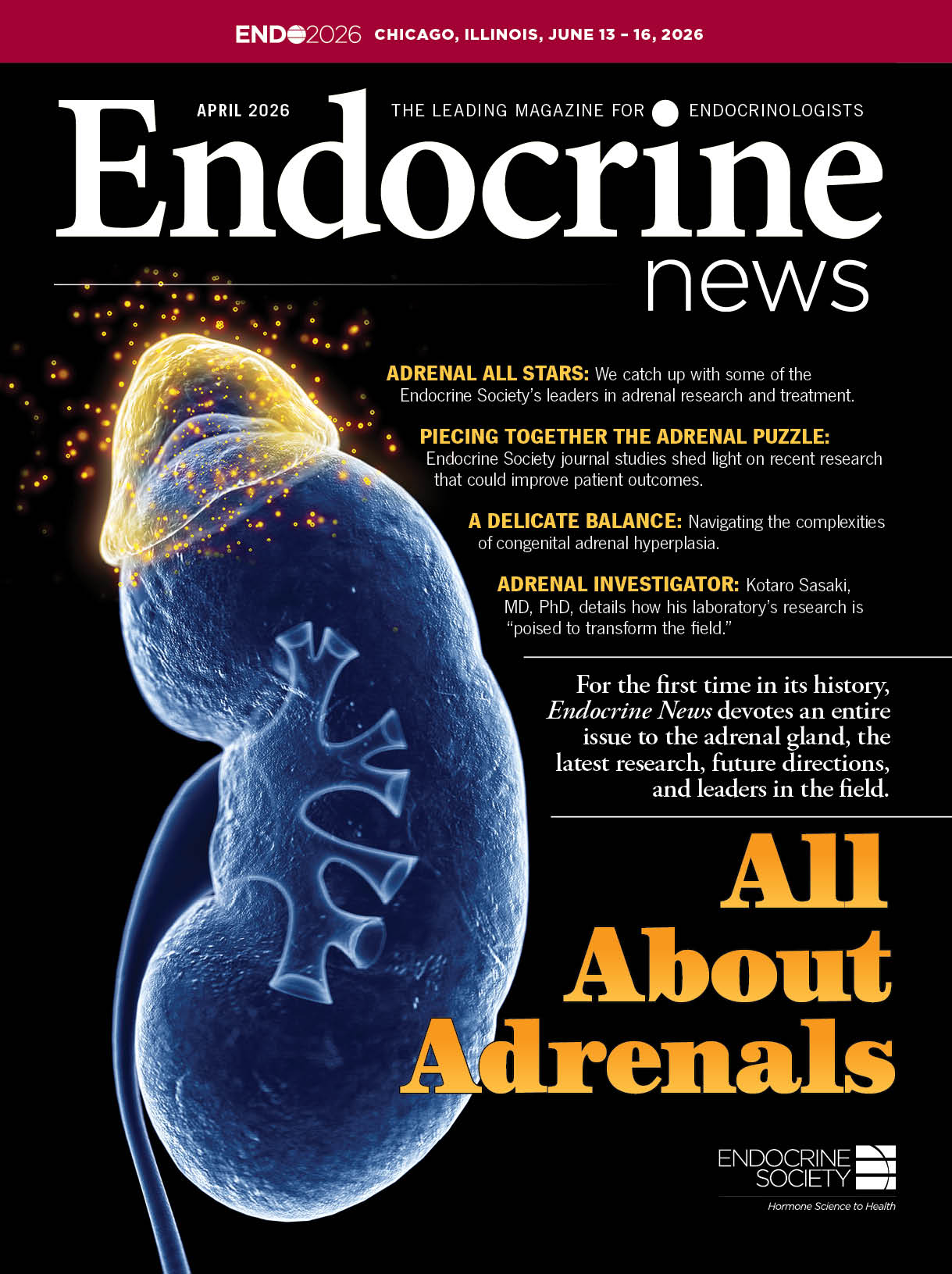
There’s something fun about “firsts” with such a well-established publication like Endocrine News. This month, I’m pleased to say, is another first: an issue devoted to the adrenal glands, those endocrine glands that “get our juices flowing” so to speak.
Senior Editor Derek Bagley has rounded up some of the Endocrine Society’s “Adrenal All Stars” for a roundtable discussion where these leaders in adrenal endocrinology discuss everything from the latest developments in treatment and research, the gaps to some developments, as well as how research informs the treatment and vice versa. According to William Rainey, PhD, the Jerome W. Conn Professor of medicine in the Departments of Molecular & Integrative Physiology and Internal Medicine at the University of Michigan, Ann Arbor, the Endocrine Society and its adrenal experts should continue to call out the social media-driven headlines that adrenal excess or deficiency is extremely common and that non-tested supplements should be used as a non-prescription therapy for non-existent adrenal diseases. “I realize this is not easy and some would say correcting these misconceptions actually provides them with a new audience,” he says, “but these non-scientific ideas are starting to have audiences at high levels within the public and governmental domain.
As it turns out, April is Adrenal Disease Awareness Month so we are highlighting some recent studies that are “Piecing Together the Adrenal Puzzle.” Kelly Horvath talks to the authors of some of these studies about how their research can hopefully improve patient outcomes going forward. All of this research was published across the Endocrine Society journal collection and they show how improved diagnostic accuracy, proper postoperative management, and a better understanding of rare adrenal pathologies can offer clinicians valuable tools when treating these patients.
Former Endocrine News associate editor and current writer of our monthly Trends and Insights column, Jackie Oberst, deals with the complexities of congenital adrenal hyperplasia (CAH) in “A Delicate Balance.” While it’s well known that constant vigilance is a much-needed asset for both the patient and the clinicians when treating people with CAH, early screening, diligent monitoring, and a comprehensive holistic approach can be vital to ensure that complications are kept at bay while the patient maintains the highest quality of life possible.
Glenda Fauntleroy Shaw talks to award-winning “Adrenal Investigator” Kotaro Sasaki, MD, PhD, about his unique research that centers around building a human adrenal gland from stem cells, why all endocrine researchers should attend ENDO every year, and even touches on the often-challenging aspects of scientific publishing. His lab began its current work about five years ago when there were few, if any “high-quality studies showing how to generate the adrenal gland in a dish from stem cells in a robust physiologically meaningful way,” he says. “Our approach has been to first understand how nature builds the adrenal gland during development, and then carefully recapitulate that process in a dish, step by step, using stem cells.”
Let me know what you thought of Endocrine News’ first adrenal issue and if you have any thoughts about future issue ideas, don’t hesitate to speak up and let us know. As always, you can always reach me at: [email protected].