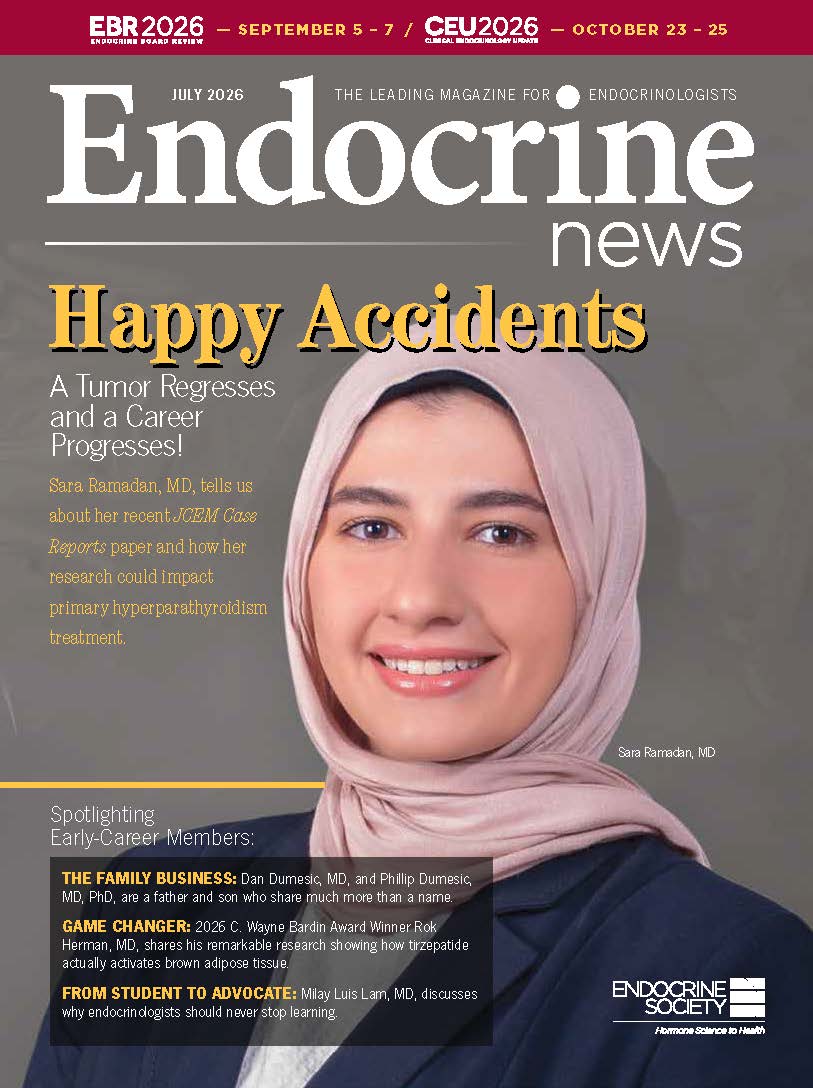
After having her study, “Unanticipated remission of primary hyperparathyroidism following cinacalcet,” published in JCEM Case Reports in March, early-career member Sara Ramadan, MD, discusses what her research could mean for the future treatment of PHPT, as well as why joining the Endocrine Society has impacted her career and her research.
When Sara Ramadan, MD, began her residency at the Boston Medical Center-Brighton, a Boston University Chobanian & Avedisian School of Medicine teaching hospital in Boston, Mass., she was interested in the field of endocrinology broadly. Two years later, that interest has crystallized, thanks at least partly to the convergence of a set of fortuitous forces. Not least among these forces, Ramadan has been working closely with her mentor at Massachusetts General Hospital, Shirin Haddady, MD, MPH, who specializes in bone and calcium metabolism. Another important factor in Ramadan’s career trajectory is her Early Career Membership in the Endocrine Society, a program designed specifically for professional development for endocrinologists during their first three post-training years.
And then there are the patients.
The Case of the Vanishing Adenoma
Primary hyperparathyroidism (PHPT), which affects up to 1% of adults and ranks just behind diabetes mellitus and thyroid disorders in worldwide prevalence of endocrine disorders, is among the more common conditions Ramadan encounters — and among the more consequential.
In “Unanticipated remission of primary hyperparathyroidism following cinacalcet,” published in JCEM Case Reports in March, Ramadan and Haddady lay out the case of a 68-year-old man referred to their clinic after routine laboratory screening revealed severe hypercalcemia, with a serum calcium 12.1 mg/dL (more than one unit above the upper limit of normal). Other test results included a markedly elevated intact parathyroid hormone (PTH) of 451 pg/mL, approximately seven times the upper reference limit. Phosphate was low at 2.2 mg/dL, and dual-energy X-ray absorptiometry revealed osteopenia, with a femoral neck T-score of −2.0.
Given that parathyroid adenoma is a common etiology of PHPT-related hypercalcemia, the team ordered high-resolution ultrasonography to localize the suspected lesion. On finding a well-demarcated, homogeneous, hypoechoic 2.3 × 1.7 × 3.0 cm mass with peripheral vascular flow posterior to the inferior right thyroid lobe, coupled with the unambiguous lab findings, they deemed the patient a candidate for surgery.
“These cases are not straightforward. The patients have already had surgery. They have altered anatomy and sometimes very ambiguous imaging, and the stakes are higher in terms of complications and decision-making. Even having conversations with these patients is different from a typical first presentation.” – Sara Ramadan, MD, resident, Boston Medical Center-Brighton, Brighton, Mass.
When preoperative cardiac evaluation revealed severe multivessel coronary artery disease, however, parathyroidectomy was deferred. He underwent percutaneous coronary intervention with stent placement and was prescribed dual antiplatelet therapy for six months. To manage his symptomatic hypercalcemia in the interim, he was initiated on cinacalcet at 30 mg daily, titrated to 30 mg twice daily.
Cinacalcet suppresses PTH secretion, thus lowering serum calcium by modulating the calcium-sensing receptor (CaSR) on parathyroid cells. It is U.S. Food and Drug Administration approved for the management of severe hypercalcemia in patients with PHPT when surgery is not an option. In this patient’s case, it was intended as “bridge therapy” while awaiting parathyroidectomy. Hence, as planned, the patient returned to the clinic for six-month follow-up, now reporting new-onset paresthesias. His serum calcium had dropped to 6.8 mg/dL and his PTH to 14 pg/mL, representing frank hypocalcemia. Oral calcium supplementation replaced the cinacalcet, and one month later, his calcium and PTH had normalized to 9.1 mg/dL and 44 pg/mL, respectively.
Although the natural history had thus far followed a fairly predictable course, that all changed at this point: a repeat neck ultrasound showed that the patient’s posterior right thyroid mass had remarkably regressed, now measuring 1.4 × 1.0 × 1.1 cm, less than 50% of its original volume. “I remember staring at the ultrasound in clinic,” says Ramadan. “We couldn’t really believe the tumor had gotten smaller. Cinacalcet’s mechanism of action doesn’t cause shrinkage of a parathyroid adenoma.” Moreover, when the drug is stopped, rebound hypercalcemia often occurs. Yet, at one-year follow-up, this patient’s serum calcium remained normal at 9.8 mg/dL and PTH at 51 pg/mL. Nearly three years later, calcium was 8.9 mg/dL, still within normal limits, on vitamin D supplementation alone.
Apoptosis or Apoplexy?
As for what might account for this medical marvel, Ramadan explains that among the proposed mechanisms is “parathyroid apoplexy,” in which hemorrhagic infarction of the adenoma triggers abrupt necrosis and rapid biochemical normalization. Parathyroid apoplexy typically involves sudden neck pain, dysphagia, or acute hypocalcemia. In this patient, however, the regression was gradual, with no acute symptoms and imaging showing preserved echotexture in the residual mass.
Another theory holds that upregulation of CaSR expression in adenomatous tissue and restoration of normal calcium signaling may contribute to gradual involution of the mass. Both in vitro and in vivo studies support this dose- and time-dependent apoptotic effect. “The clinical picture was more consistent with slow apoptotic involution than with an acute infarction event, but we can’t really prove it without a biopsy and examination of the cellular pathology,” Ramadan acknowledges.
The markedly elevated baseline PTH also raised a flag for parathyroid carcinoma, which accounts for fewer than 1% of PHPT cases but typically presents with PTH more than three times normal. But, again, the clinical features argued against malignancy, she explains. The adenoma was homogeneous and well-demarcated on ultrasound, calcium was elevated but below the threshold typically associated with carcinoma, and the patient ultimately achieved and sustained eucalcemia.
Ramadan’s case joins only a handful of published reports documenting apparent cinacalcet-associated remission in PHPT, including cases of outright adenoma disappearance, nine-year sustained remission on high-dose therapy, and at least one instance complicated by vocal cord palsy following adenoma necrosis. She is candid about the challenges of studying this phenomenon more systematically. Surgery remains a highly effective and safe cure for PHPT, with cure rates exceeding 95%, making it difficult to ethically justify randomizing patients to medical therapy alone. “For a prospective trial, you’d need a very specific subset of patients who don’t fit the criteria for surgery — people for whom medical therapy is the only option,” she explains. “And these cases are very sporadic and rare, so you’d need large numbers and long follow-up. It might not happen for everyone.”
The most informative next step, she believes, would be histopathology: biopsying adenomas in the small pool of patients who respond to cinacalcet and examining their cellular architecture under the microscope. For the current patient (who remains eucalcemic), Ramadan suspects that further investigation would depend on circumstances. “He was reluctant to have surgery in the first place, so if he started having recurrent symptoms and was looking for an explanation, he might be amenable,” she says.
What Comes Next?
Meanwhile, the cinacalcet case helped sharpen Ramadan’s clinical and research focus to a particularly challenging corner of the field: recurrent primary hyperparathyroidism. “These cases are not straightforward,” she says. “The patients have already had surgery. They have altered anatomy and sometimes very ambiguous imaging, and the stakes are higher in terms of complications and decision-making. Even having conversations with these patients is different from a typical first presentation.”
Working in the Boston Medical Center healthcare system, a large safety-net institution, has given Ramadan exposure to the full complexity of the disease, including its intersection with health disparities. Substantial racial differences in PHPT prevalence are well recognized: African American females face the highest risk and tend to present with more severe biochemical disease, driven by a combination of genetic, metabolic, and healthcare access factors. Ramadan’s research agenda is oriented toward understanding why recurrence happens, identifying affected patients earlier, and optimizing management beyond repeat surgery, with a specific interest in outcomes among underserved populations.
“When I initially joined during my first year of residency, I was still finding my voice and figuring out which direction in endocrinology I was heading. Getting access to people who are further along, not just for mentorship in the traditional sense, but to see how they build their careers and define their niches, has been really valuable.” – Sara Ramadan, MD, resident, Boston Medical Center-Brighton, Brighton, Mass.
Her Endocrine Society Early-Career membership is already serving her well here. She says the access it provided — to mentors, to the annual conference, and to a forum for peer exchange — turned out to be more valuable than she had anticipated. “When I initially joined during my first year of residency, I was still finding my voice and figuring out which direction in endocrinology I was heading,” she says. “Getting access to people who are further along, not just for mentorship in the traditional sense, but to see how they build their careers and define their niches, has been really valuable.”
ENDO has been a particular highlight. Ramadan describes attending case report sessions and watching experienced clinicians work through complex presentations in real time, helpful instruction for someone still orienting herself in the specialty. The exhibition floor exposed her to technologies not available at her program that she was later able to bring back to patients as tangible teaching tools. “That was life-changing for me, being able to incorporate it into my day-to-day clinical work,” she says. She also formed professional connections that have continued beyond the conference itself. This year, she is particularly looking forward to a full-day mentoring session with program directors — timely, since she is currently applying for fellowship and will be relocating to Seattle after completing her final year of residency.
For residents and fellows still mapping their trajectory in endocrinology, Ramadan’s endorsement of the Early Career membership is unequivocal. “It puts you in a spot where you’re connected with everyone and everything, and you’re up to date,” she says. “If you’re looking for connections with people who are more established in the field or trying to figure out what you’re drawn to and how to approach it, I recommend joining. It has been a great experience for me.”
Horvath is a freelance writer based in Baltimore, Md. In the June issue, she wrote about “Low Testosterone in Obesity: Should We Treat or Not?,” a debate session at ENDO 2026.