

ENDO 2026 was another for the record books, which was impressive for a time when healthcare – and the research that informs it – can seem uncertain. But endocrinologists are unflappable, and it was evident this past June.
Miles Davis once famously said of jazz that it’s not the notes you play; it’s the notes you don’t play. Jazz was born in New Orleans but during the Great Migration, Chicago welcomed jazz musicians and other artists with open arms, and jazz flourished. Jazz (and music) enthusiasts in Chicago like to say that jazz was born in New Orleans but grew up in Chicago. Different notes were introduced, and the impact and influence spread throughout the world.
It’s fitting that ENDO 2026 was held in Chicago, in this welcoming and transformative city, in such a turbulent past couple of years. It’s no secret and it’s not at all political to say here that experts in endocrinology have had to go through budget cuts and altogether cut funding, but endocrinologists have kept their heads down and continued to work for the benefit of patients, whether at the bench or bedside.
ENDO 2026 was not only a testament to the resiliency of the field, but also the breadth and wealth of endocrinology. But perhaps the biggest piece of news to come out of the meeting (and indeed the last few years) is the introduction and continuing improvement of GLP-1 medications – once used for patients with diabetes but now approved for treating patients with obesity as well.

Weight for It
About an hour or so after delivering their plenary talks, Daniel Drucker, the 2025 recipient of the Endocrine Society’s Fred Conrad Koch Lifetime Achievement Award, and professor of medicine at the Lunenfeld Tanenbaum Research Institute of Mt. Sinai Hospital and the University of Toronto in Toronto; and Recipient of the Endocrine Society’s 2025 Roy O. Greep Award for Outstanding Research, Barbara Kahn, MD, the George Richards Minot professor of medicine at Harvard Medical School and the vice chair for research strategy in the Department of Medicine at the Beth Israel Deaconess Medical Center, sat down for a Q&A session with ENDO attendees on the expo floor.
During the chat, current Endocrine Society president Nanette Santoro, MD, the E. Stewart Taylor Chair of Obstetrics & Gynecology at the University of Colorado School of Medicine, asked about the health benefits of ice cream for diabetes, citing an April 2023 article in The Atlantic titled, “Nutrition Science’s Most Preposterous Result,” describing a Harvard doctoral student named Andres Ardisson Korat, whose research concluded that if people with diabetes ate half a cup of ice cream every day, they could reduce their risk of heart disease. The dek of the article by David Merritt Johns reads, “Studies show a mysterious health benefit to ice cream. Scientists don’t want to talk about it.”
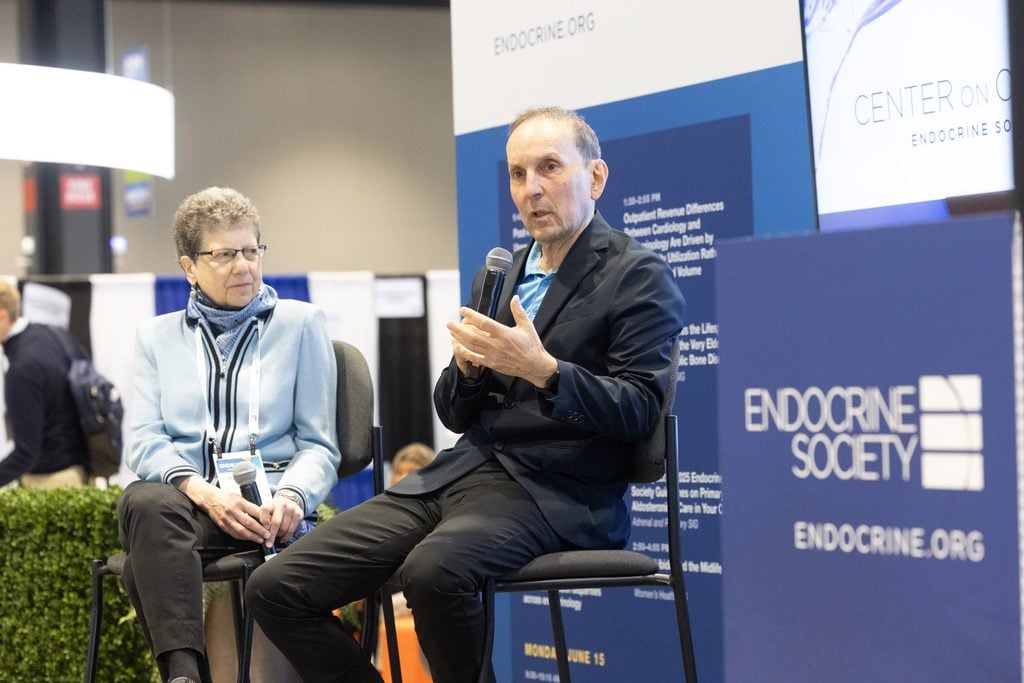
Kahn didn’t mind talking about it. “My hypothesis on why eating a little bit of ice cream would delay diabetes onset is that it slows down absorption of carbohydrates,” she said. “You don’t get the same huge peak in carbohydrates after a meal that you’ve got that lipid mixed in with the meal.” But Kahn also pointed out that the fatty acid esters of hydroxy fatty acids found in ice cream are also found in breast milk and other foods like apples and broccoli.
The next question from an attendee was what weight loss therapy would look like 10 years from now. “Let’s not lose sight of the fact that, ideally in 2036, we would have figured out why have we gone in 40 years from a population of BMI of 23 or 24 through this epidemic of overweight or obesity,” Drucker said. “[Hopefully by] 2036, we would have figured this out — implement changes in our environment and our food system and things we’ve identified as being important for this independent genetics, this massive surge in BMI, and we won’t need any GLP-1 medicines in 2036. If we do, there’ll be dozens of them available and they’ll be very affordable.”



GLP medications of course aren’t a silver bullet for treating or curing obesity; lifestyle changes still matter. Kahn noted that on the whole expo floor, of all the vendors, there was not one promoting a stationary bike. “You guys could all be riding a bike while we’re doing this talk,” she said, “It looks to me, and Dan can speak to this more, that the [GLP-1] drugs are incredibly effective. Having said that, there’s still some patients who choose bariatric surgery because it’s a one and done as opposed to dealing with the medications. If you’re looking for fertile areas of research, trying to change the environment to change obesity is very important.”
Drucker agreed, questioning chemicals in our environment, as well as foods and especially processed foods. “What is it about our foods and processed foods and the way they’re manufactured?” he said. “Because I think we would all rather prevent disease than treat disease.”
Breaking Barriers
But while GLP-1 medications seem to signify a turning point in patients with obesity, for some, affordability and access to these treatments aren’t always available. Drucker, who is based in Canada, says that for a month of semagulide it costs about $78 Canadian. “It’s like the cost for an Uber ride into Chicago,” he said. “And many other countries are getting generic semaglutide as well.”
In session titled, “Breaking Barriers: Addressing Endocrine Disorders in Underserved Populations,” Alicia Diaz‑Thomas, MD, MPH, a professor of Pediatrics and senior associate dean for Institutional and Faculty Affairs at the University of Nevada, Reno School of Medicine; and Eric Bomberg, MD, MAS discussed the hurdles many people have to face to purchase these medications without going bankrupt.
Diaz-Thomas, who moderated the session, led off by citing the 1899 study by WEB Du Bois, which concluded that Black Americans have higher mortality rates than White Americans, Bomberg told the audience that non-Hispanic White Americans have more access to bariatric surgery, especially with private insurance, while noting there are nine medications currently approved for treating obesity. “Black and Hispanic patients have to jump through more hoops, so to speak,” Bomberg said. “Asian, Black, and Hispanic people are less likely to use these new meds, and that’s accounting for education.”
The question then becomes what can we do? Bomberg argued that obesity needs to be recognized as a disease and that biases about weight gain need to be addressed. “It’s great we have GLP-1 meds and the like but that means nothing if people don’t have access to them,” he said.
Worth the Weight
And while GLP-1s have dominated the news cycle recently, and much of ENDO, that’s not all endocrinologists are working on. And even then, researchers are echoing what Drucker and Kahn said during their Q&A session: behavioral factors like setting weight goals. Researchers led by Hans Johnson, found that in a collaborative study with 80,000 adults using tirzepatide, the team found that women tended to lose more weight on tirzepatide than men and that pre-existing conditions such as type 2 diabetes, high cholesterol, hypertension, metabolic liver disease, and obstructive sleep apnea were associated with less weight loss – another testament to individualized treatment options.
Meanwhile, Chinese researchers showed that people with type 2 diabetes who nap longer than 30 minutes every day increase their risk of developing metabolic dysfunction-associated steatotic liver disease. “Our public health message is to nap wisely,” said Xuejiang Gu, MD., PhD, executive director of the Endocrinology Department at the First Affiliated Hospital of Wenzhou Medical University in Wenzhou, Zhejiang.
A study presented on Sunday of ENDO suggested that the FDA-approved non-hormone treatment fezolinetant found the menopausal medication improved hot flashes, depression and anxiety in women. (The study was industry-sponsored.) Researchers led by Pauline M. Maki, Ph.D., professor of psychiatry, psychology and OB/GYN at the University of Illinois Chicago College of Medicine showed that fezolinetant shows benefits similar to what was seen in clinical trials. “That’s important because clinical trials generally have restrictive criteria for study enrollment, “Maki said. “Study participants are generally healthier than the general population.”

Constant Evolution
Miles Davis told Nancy Reagan that he had “changed the course of music five or six times” when Reagan asked him why he was invited to a White House dinner in 1987. After attending ENDO, it’s easy to see that endocrinologists are constantly changing the course of healthcare. GLP-1 medications have been a lifesaver for many patients with obesity, a disease that begets almost 200 other disorders.
It’s clear that endocrinology is constantly evolving. When Davis said of jazz that that it’s about the notes don’t play, he was referring to the beauty of silence between the notes, feeling the rhythm. And not to speak for the legendary Illinois-born Davis (who did indeed change the course of music), but maybe when he said that famous quote, it could be interpreted as “the notes you haven’t played yet.”