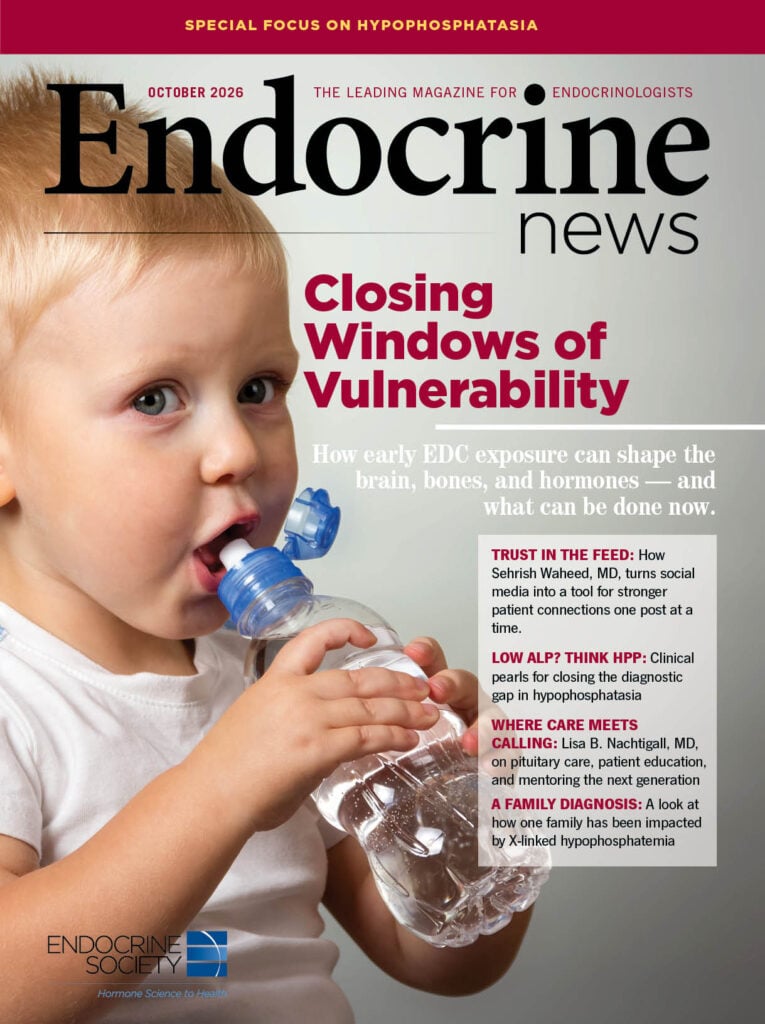

Early-life exposure to endocrine-disrupting chemicals may affect brain function, bone development, and hormonal programming during periods of heightened vulnerability. Three studies examine these risks and identify individual, clinical, regulatory, and product-design strategies that may reduce exposure or mitigate consequences.
With October taking a pediatric health focus at Endocrine News, this article explores three studies that examine how endocrine-disrupting chemicals (EDCs) interfere with human development and seek ways to ameliorate these exposures.
Despite our growing awareness that EDCs are linked with all manner of adverse human health outcomes, including altered neurodevelopment and associations with obesity and attenuated growth, they continue to be widely used in used in consumer products, electronics, and agriculture. The studies profiled here demonstrate that early life represents a period of particular vulnerability to EDCs’ harms.
Early Phthalate Exposure
In research presented at ENDO 2026 in June, Osvaldo Juan Ponzo, MD, PhD, professor of physiology at University of Buenos Aires School of Medicine in Buenos Aires, Argentina, demonstrated that mature male rats exposed to the EDC di-(2-ethylhexyl) phthalate (DEHP) during pre- and perinatal development have increased anxiety. DEHP is one of the most commonly used plasticizers globally, used to make certain consumer products (e.g., medical devices, toys, shower curtains, raincoats) more flexible.
As DEHP and its metabolites have been shown to interfere with the reproductive and nervous systems (among others) in both animals and humans, Ponzo and team sought to determine whether g-aminobutyric acid (GABA) or testosterone was involved in regulating the effects of DEHP on anxious behavior in adult male rats. “In other words,” says Ponzo, “we wanted to investigate whether early-life exposure could induce a lasting ‘imprinting’ effect on the neural structures involved in the regulation of behavior and anxiety. Furthermore, the rising incidence of behavioral and neurodevelopmental disorders in humans together with epidemiological evidence linking exposure to endocrine-disrupting chemicals with adverse neurodevelopmental outcomes, such as the increase in autism, provided an additional rationale for investigating the mechanisms underlying these behavioral alterations.”
The team suspected that GABA and testosterone might remediate some of the harmful effects because of the known interaction between androgenic and GABAergic signaling in the regulation of neural function and behavior. “On the one hand, testosterone can modulate the GABAergic system and may therefore counteract the anxiogenic effects associated with endocrine-disrupting exposure,” says Ponzo. “On the other hand, these endocrine disruptors have an anti-androgenic (i.e., anti-testosterone) effect that induces anxiety; the aim, therefore, was to demonstrate that the competition between testosterone and the anti-androgenic phthalate for the receptor could reverse this behavioral alteration.”

“This work demonstrates that exposure to EDCs during critical periods of development may have long-lasting consequences for brain function and behavior. Also, the rising prevalence of behavioral disorders in humans — such as anxiety-related issues — appears to be linked, at least in part, to the increasing exposure over recent decades to industrial substances known as endocrine disruptors.”
Osvaldo Juan Ponzo, MD, PhD, professor of physiology, University of Buenos Aires School of Medicine, Buenos Aires, Argentina
They gave pregnant female rats oral DEHP 30 mg/kg daily, starting with day 1 of gestation through weaning. At maturity (70 days old), the rats were placed in an elevated plus maze (EPM), which, as its name suggests, is shaped like a plus sign with two open and two closed arms enclosed by high walls. As the EPM test draws on rodents’ natural aversion to open spaces and heights, it allowed the scientists to measure the duration spent in both arms as well as their freezing time (time spent motionless), head-dipping time (head extended beyond the EPM arms), and stretch-attend posture time (body is stretched forward while the hind limbs remain in place).
The exposed rats not only spent less time in the open arms and more time in the closed arms, compared to controls, they also showed significantly more freezing and stretch-attend time and significantly less head-dipping time, behavior consistent with anxiety. As these behaviors were reversed in those rats who received GABA agonists or testosterone at various pretest time points, the researchers concluded that they are a consequence of neuroendocrine alterations. “This work demonstrates that exposure to EDCs during critical periods of development may have long-lasting consequences for brain function and behavior. Also, the rising prevalence of behavioral disorders in humans — such as anxiety-related issues — appears to be linked, at least in part, to the increasing exposure over recent decades to industrial substances known as endocrine disruptors,” says Ponzo.
PFAS Exposure and Bone Health in Adolescence
In “Per- and polyfluoroalkyl substances and adolescent bone mineral density: assessing periods of susceptibility,” published in Journal of the Endocrine Society in March, Jessie P. Buckley, PhD, of the Department of Epidemiology, Gillings School of Public Health at the University of North Carolina in Chapel Hill, N.C., and team sought to identify specific temporal windows during childhood when certain EDCs might exert greater adverse influence on bone mineral accrual.
“Bone health is understudied with respect to how the environment might be causing, or contributing to, lower bone mass accrual during childhood,” says Buckley. What initially led her to study whether per- and polyfluoroalkyl substances (PFAS) might be affecting how children’s bones develop, however, was a bit of an accident. Years earlier while studying body mass index, Buckley noticed something odd: When she looked at height and weight separately, the children with higher EDC exposures had lower stature. “That wasn’t my hypothesis,” she explains, “but it got me thinking about why that would be.” She turned to the animal literature, where EDCs like PFAS are hypothesized to act as obesogens by causing mesenchymal stem cells in bone marrow to differentiate into adipocytes instead of osteocytes, a process mediated by PPAR-γ (peroxisome proliferator-activated receptor gamma). Essentially, some EDCs behave as a PPAR-γ agonist and give it the wrong signal. “If that’s the reason they cause obesity,” she remembers thinking, “then they’re probably also not good for bone health.”
To test this newly emerging hypothesis in humans, Buckley and team used data from a prospective pregnancy and birth cohort called the Health Outcomes and Measures of the Environment (HOME) Study. Pregnant participants were recruited from March 2003 to January 2006, and 218 of their offspring were eligible for Buckley and team’s current study, which required that PFAS be measured in their serum at delivery at ages three, eight, and 12 years as well as completing a bone mineral density (BMD) assessment via dual x-ray absorptiometry (DXA) at age 12. They specifically looked at four PFAS widely persistent in the environment, found in everything from nonstick cookware to water supplies, including perfluorohexane sulfonic acid (PFHxS), perfluorooctane sulfonic acid (PFOS), perfluorooctanoic acid (PFOA), and perfluorononanoic acid (PFNA). These four have biologic half-lives in humans ranging from two to nine years and have been detected in human bone tissue. The team wanted to know if serum PFAS concentrations measured at ages 8 and 12 years would have stronger associations with lower BMD than the earlier measures, given that peak BMD accrual occurs in early adolescence.

“Regulatory approaches can reduce exposure across entire populations,” Buckley says, “this can be helpful for many sources of PFAS that are difficult for individuals to avoid. Even without regulation, we have seen that consumer choices can impact chemical exposures when individuals use the power of the pocketbook to avoid those chemicals in the things they purchase. If we come at it from multiple angles, hopefully we can move the needle.”
Jessie P. Buckley, PhD, of the Department of Epidemiology, Gillings School of Public Health, University of North Carolina, Chapel Hill, N.C.
Unfortunately, at least some of their hypothesis proved correct: Higher serum PFOA concentrations were consistently associated with lower BMD Z-scores at the distal radius. Associations for other PFAS differed by exposure assessment timing, skeletal site, and sex. Fortunately, on the other hand, the team did not have to stop there. “This is a pretty unique cohort,” says Buckley. “They were enrolled as children in the early 2000s, and we’ve been following them ever since. They’re very dedicated participants, and our staff has remained connected with them. Age 12 is at the beginning of a really fast period of bone mass accrual, and we wanted to know if the associations we saw at 12 would still be evident as the kids reached adulthood.” Preliminary findings from a repeat DXA scan at age 18 are showing similar results so far, lending further support to the idea that some periods of growth and development have heightened susceptibility to PFAS’ effects. These findings appear in “Associations of gestational serum per- and polyfluoroalkyl substances (PFAS) concentrations with late adolescent bone mineral density in the Health Outcomes and Measures of the Environment (HOME) Study,” an abstract published in June in Environmental Epidemiology by Singareddy et al., including Buckley.
Buckley remains not only grateful to the cohort for their ongoing dedication to this important work but also hopeful. “Although one solution is to use less PFAS in the future, that doesn’t address the fact that so many people have already experienced PFAS exposure,” she says. This reality prompted a follow-up question: Do protective factors exist? “In a separate study, we found that the associations of PFAS with lower BMD were evident among adolescents with lower calcium intake and physical activity,” Buckley explains. “But we didn’t see an association among those with a more optimal diet or physical activity.”
Two intervention pathways become clear here. One is using less PFAS. Buckley notes that several states have introduced policies to reduce PFAS exposure, and awareness is spreading of their dangers. “Regulatory approaches can reduce exposure across entire populations,” Buckley says, “this can be helpful for many sources of PFAS that are difficult for individuals to avoid. Even without regulation, we have seen that consumer choices can impact chemical exposures when individuals use the power of the pocketbook to avoid those chemicals in the things they purchase. If we come at it from multiple angles, hopefully we can move the needle.” The second pathway is accessible now: “More physical activity and better diets are healthy for more than BMD alone and expanding access to safe play spaces and nutritious food would help even those who have already been exposed to PFAS.”

For clinicians, Buckley hopes the team’s work helps broaden the diagnostic lens. “It’s important to think about a person’s environment when trying to understand why their health is a certain way,” she says. She points to practicing endocrinologists who have begun testing patients for PFAS when they suspect high exposure, and a National Academies of Sciences, Engineering, and Medicine report titled “Guidance on PFAS Exposure, Testing, and Clinical Follow-up.” The larger goal, she says, is “to raise awareness that the environment is important, even for bone health, which I think is under-acknowledged.” She adds that the Endocrine Society has led the way in bringing attention to the potential health effects of endocrine-disrupting chemicals in reports like “EDC-2: The Endocrine Society’s Second Scientific Statement on Endocrine-Disrupting Chemicals.”
“How much bone you accrue during childhood is so important for your lifelong future risk of osteoporosis and fractures in adulthood,” she says. “The lag time between childhood and adulthood makes it hard to do these studies that show the longitudinal link all the way across the life course, but studies like ours are beginning to track the longer-term impacts of early life exposures.” Zooming out, Buckley situates her work inside a much larger exposure problem: “It’s so unfortunate how wide-reaching these effects are,” she says. “Almost everyone in the United States has PFAS in their body. We studied four PFAS, but there are thousands. So, as we move forward, understanding what some of these newer PFAS are doing, and whether they’re also involved in processes that affect bone health and other outcomes, is important.”
Preventing EDC Exposure from Breast Milk
Also presented at ENDO 2026 and published in August in the European Journal of Endocrinology, “Exposure to endocrine-disrupting chemicals in breast milk and infant urine samples: findings from the LIFE-MILCH project,” illustrates that some of the intervention methods Buckley discussed can actually work in practice.
Maria Elisabeth Street, MD, PhD, associate professor and director of the Division of Pediatric Endocrinology at the University of Parma and University Hospital of Parma, in Parma, Italy, and team undertook a longitudinal study of EDCs in 336 infant–mother dyads enrolled in the LIFE-MILCH project. “After birth, most EDC exposure will occur through feeding. Infancy is a particularly sensitive developmental window and the effects of exposure to EDCs may interfere with hormonal programming with consequences that only become apparent years later,” said Street. The team measured levels of more than 50 different EDCs, including bisphenols (BPA), polycyclic aromatic hydrocarbons, phthalates and metabolites, parabens, polar pesticides, and pyrethroids from samples collected one, three, and six months after birth that confirmed breast milk as a vehicle of environmental exposure. These and other results led Street and team to identify a broader objective: identifying realistic and modifiable sources of exposure while protecting and promoting breastfeeding, which has become the LIFE-MILCH alliance. “Breast milk is the optimal source of nutrition for infants, and breastfeeding must continue to be strongly encouraged,” she says.

“After birth, most EDC exposure will occur through feeding. Infancy is a particularly sensitive developmental window and the effects of exposure to EDCs may interfere with hormonal programming with consequences that only become apparent years later.”
Maria Elisabeth Street, MD, PhD, associate professor and director, Division of Pediatric Endocrinology, University of Parma and University Hospital of Parma, Parma, Italy
The LIFE-MILCH campaign translates research findings into practical information for three groups: women of childbearing age, pregnant or breastfeeding women, and health professionals, says Street, reaching them through schools, clinics, antenatal classes, and training sessions. Manufacturers are part of the picture too, through monitoring and voluntary agreements to cut EDC contamination in infant products. “The campaign’s effectiveness,” she explains, “is being evaluated through a second round of biomonitoring in mother-infant pairs rather than through awareness measures alone.”
LIFE-MILCH also offers the following reasonable exposure-reduction measures, framed to avoid causing mothers to become anxious or to stop breastfeeding:
• Use glass, paper, or suitable reusable containers and packaging.
• Avoid heating food in plastic unless the container is explicitly designed for it.
• Reduce reliance on canned and heavily packaged food.
• Follow a varied, balanced diet and wash vegetables and fruit well.
• Use stainless-steel or ceramic cookware when appropriate, particularly if non-stick surfaces are damaged.
• Choose personal-care products with simpler ingredient lists and, where possible, products identified as free of relevant phthalates or bisphenols.
• Limit unnecessary use of fragrances, air fresheners, pesticides, and harsh cleaning products.
• Ventilate the home regularly and reduce indoor dust.
For clinicians, Street and team’s central message is to support breastfeeding. “These results should not be interpreted as evidence against it.” Clinicians can ask a few practical questions about food storage, personal-care products, and household chemicals as part of preventive maternal and child health, paired with a clear caution that detection of a chemical does not automatically establish clinical harm in an individual child. Says Street: “Our study primarily identifies population-level exposure patterns. The broader solution requires public-health action, safer product design, continued biomonitoring, and appropriate regulation, alongside individual guidance.”
Looking ahead, the team’s priority is completing a longitudinal analysis of the full LIFE-MILCH cohort, treating breast milk and infant urine as connected trajectories rather than isolated samples, and studying realistic chemical mixtures rather than single compounds. From there, Street wants to connect exposure to outcomes like growth, adiposity, neurodevelopment, and pubertal timing, while also testing whether the prevention campaign itself measurably reduces exposure. Longer term, the group is moving toward proof-of-concept in vivo mixture studies and work on epigenetic effects in breast milk.
Connecting the Dots
As this research shows, EDCs can affect development during sensitive early-life periods, however, measures exist that may reduce exposure or lessen its consequences. Taken together, these three studies highlight the importance of considering early-life exposure to EDCs as a potential risk factor for later health alterations.
Horvath is a freelance writer based in Baltimore, Md. In the September issue, she wrote “Minding the Gaps: What Happens When Pediatric Patients with Pituitary Tumors Become Adults?”