The Endocrine Society and Keystone Symposia are teaming up to host a series of meetings about the intersection of hormone signaling and cancer, diabetes, and cardiometabolic disease.
The series kicks off with Hormonal Influences on Immunity and Cancer Across the Lifespan, taking place Oct. 5 – 8, 2026, in Breckenridge, Colo. This event will be followed by meetings on diabetes and cardiometabolic disease, both taking place in February 2027 in Colorado.
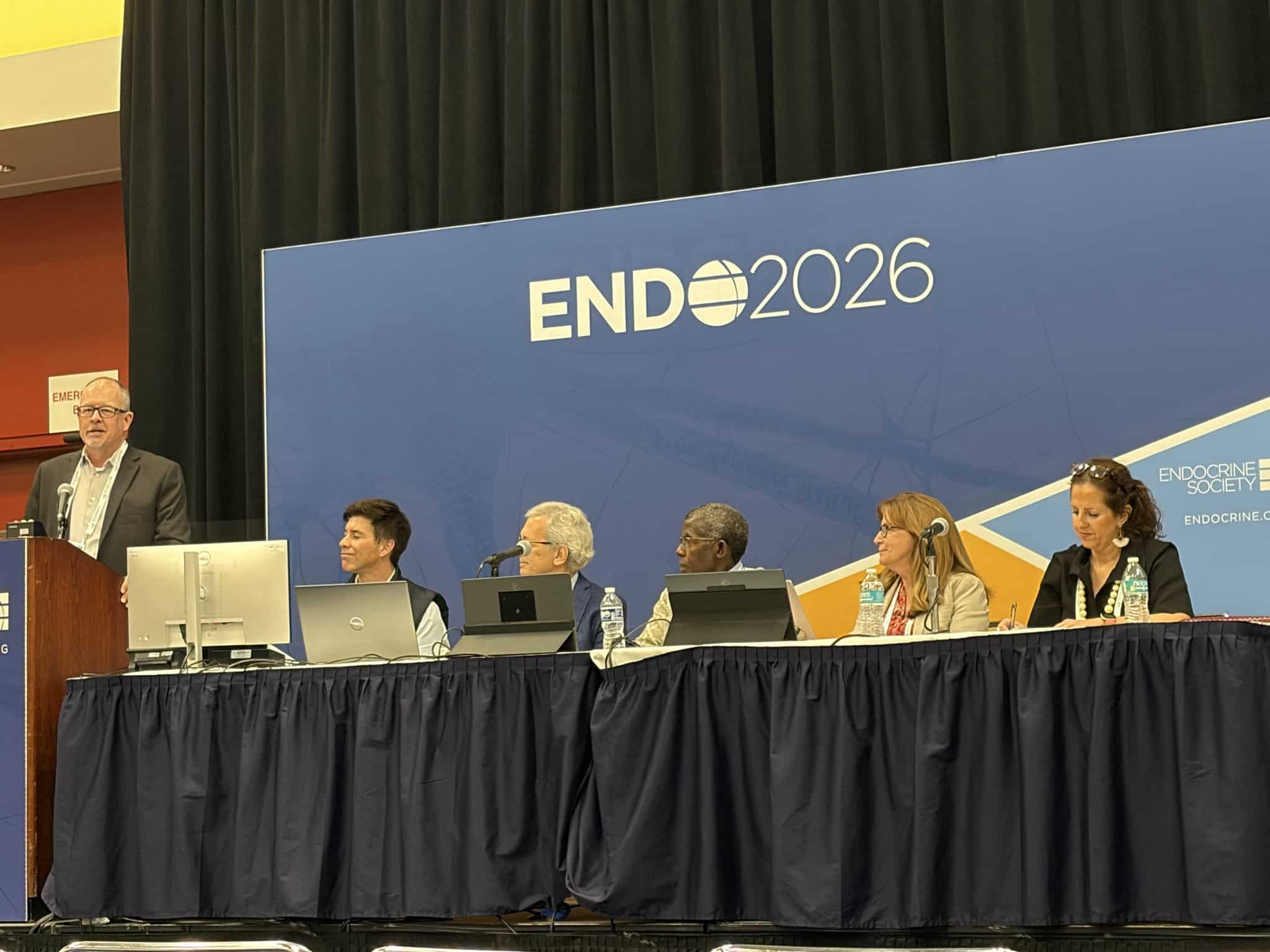
Researchers and representatives from Keystone Symposia and the Society discussed the conference series’ intersectional approach during a symposium held in June at ENDO 2026 in Chicago, Ill., as shown in the photo above.
As scientists attempt to absorb and comprehend large amounts of data being published, networking with researchers in the same specialty can limit the speed of advancement, said Keystone Symposia President and CEO James Baumgartner, PhD. Keystone Symposia and the Society are convening experts from various fields around a topic of mutual interest. This approach is where we are seeing the most scientific progress, Baumgartner said.
“Biology doesn’t know any boundaries. Health and disease don’t know boundaries,” he said during the symposium. “And so the most exciting discoveries we’re seeing today through our organization actually are at the interfaces between different disciplines, but also along the spectrum, from discovery to translational to clinical.”
This approach to knowledge exchange and networking can spark new ideas. The conferences will allow basic and translational researchers to build connections and learn of approaches that can inspire new research directions, said Prof. Ines Pineda Torra, PhD, of Fundacion Progreso y Salud in Seville, Spain.
“Biology doesn’t know any boundaries. Health and disease don’t know boundaries. And so the most exciting discoveries we’re seeing today through our organization actually are at the interfaces between different disciplines, but also along the spectrum, from discovery to translational to clinical.”
James Baumgartner, PhD, Keystone Symposia President and CEO
“Coming to these meetings, you see the context, you see where your work fits, you see other people’s work, and you think, ‘That’s what I want to do, but in my system,’” Torra said. “And you start connecting all these things.”
The intersectional approach creates a space for academic researchers to interact with those working in industry and in therapeutic innovation, said Endocrine Society Past-President E. Dale Abel, MD, PhD, during the symposium. The conference series also allows early career professionals who are establishing research careers to meet titans of the field in an intimate setting. This strategy can yield rich conversations and spur new collaborations.
“I’m proud to say both the Endocrine Society and Keystone Symposia have had really an unflinching commitment to ensuring that both organizations remain a place in which those who are emerging in science can have a home, can have a voice, and also can have access to mentorship and career support,” Abel said.
The Society and Keystone Symposia each bring a stellar reputation for scientific excellence to this partnership. The collaboration will yield exciting coordinated programming that benefits researchers, said Roger Cone, PhD, Mary Sue Coleman Director of the Life Sciences Institute at the University of Michigan in Ann Arbor, Mich.
“I’m proud to say both the Endocrine Society and Keystone Symposia have had really an unflinching commitment to ensuring that both organizations remain a place in which those who are emerging in science can have a home, can have a voice, and also can have access to mentorship and career support.”
Endocrine Society Past-President E. Dale Abel, MD, PhD
“So I think each society and each meeting brings novel strengths, and as the two organizations work together, they’ll be able to create new things that don’t exist now at either of the two institutions,” Cone said. “That goes for everything from advancing basic science to doing everything we can to advance the careers of young people to adding with translation from the bench to the bedside and back again.”
Registration for the first partnered meeting, Hormonal Influences on Immunity and Cancer Across the Lifespan, is open now.