

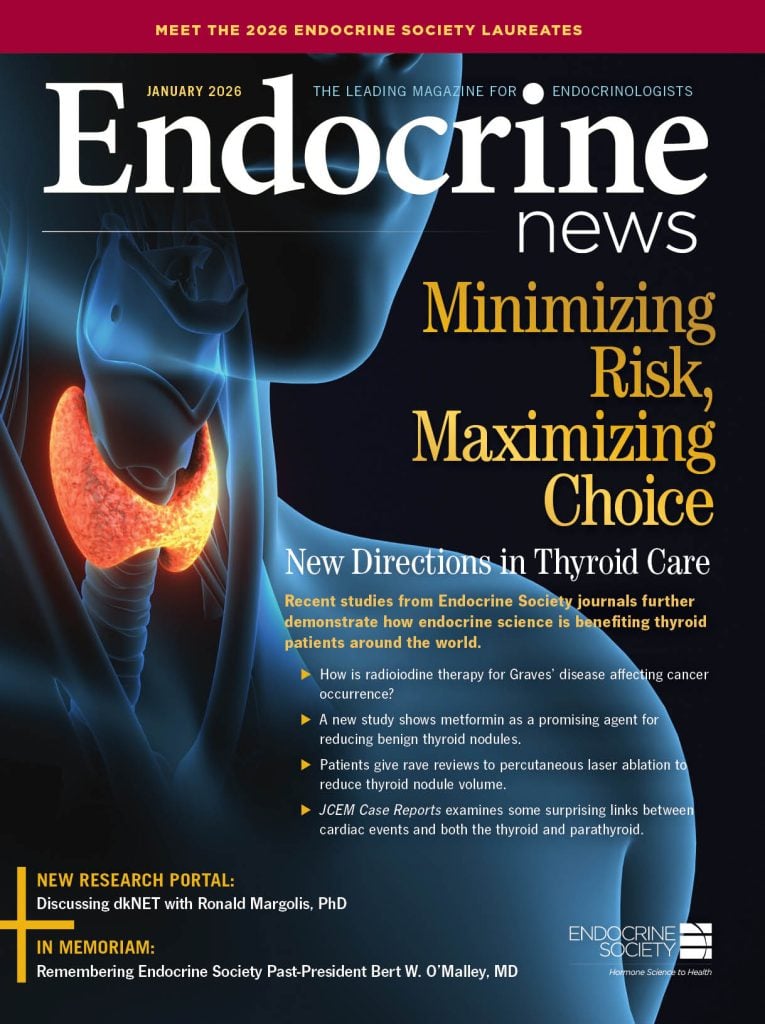
As we leave 2025 behind and look forward to the new year ahead, what better way to kick off 2026 than with a multi-page tribute to the latest class of Endocrine Society Laureate Award winners?
In “Meet the 2026 Laureates,” we feature this year’s stellar array of legends of endocrinology from around the world. This year, Neal Learner asked them for their advice to younger endocrinologists just starting out as well as the impact the Endocrine Society has had on their own careers. When asked what advice she would give to early-career endocrinologists, 2026 Outstanding Mentor Award recipient Patricia Lee Brubaker, PhD, stresses how you need to trust your trainees because “they will keep the lab going while you are gaining all the other skills you need to be successful (i.e., grant writing, teaching),” she says. “But you also need to ensure that they have the opportunity to present their work at conferences such as the Endocrine Society Annual Meeting, where they will grow in confidence and build the networks essential to their own careers.” Attending ENDO is always good advice no matter what stage of your career you find yourself!
To commemorate Thyroid Awareness Month, Kelly Horvath has looked at some recent studies from The Journal of Clinical Endocrinology & Metabolism that give even more evidence of how endocrine science is continually impacting and improving how patients are receiving care. In “Minimizing Risk, Maximizing Choice: New Directions in Thyroid Care,” studies that look at how radioiodine therapy for Graves’ disease can impact cancer occurrence and the potential usefulness of pharmacologic treatments for benign thyroid nodules to how percutaneous laser ablation for thyroid nodules could be minimally invasive treatment option. Regarding the latter procedure, Giovanni Gambelunghe, MD, PhD, from the Endocrine Unit at Clinica Liotti in Perugia, Italy, says that the study he authored confirms that the procedure is not only safe and effective in the short term, but in the long term as well. “What impressed me most, however, was that the overwhelming majority of patients reported they would willingly undergo the procedure again,” he says, adding that in itself is “strong evidence of the technique’s truly minimally invasive nature. Clinicians should feel confident in adopting this technique as part of their therapeutic armamentarium.”
The National Institutes of Health’s National Institute of Diabetes and Digestive and Kidney Diseases has created a new research portal that promises to be a boon for endocrine scientists around the world. Senior Editor Derek Bagley speaks to emeritus Endocrine Society member and longtime researcher Robert Margolis, PhD, about how this new avenue will improve scientists’ ability to reach fellow researchers from all corners of the globe. In “New Research Connections,” we delve into the details of dkNET, which will give researchers and clinicians cross-disciplinary access to critical new information. Margolis says that he hopes researchers will be energized by the knowledge that there is a portal with real and relevant content that can help them in their efforts to maximize their investigations. “dkNET provides a single-entry point to a wealth of information, data, services, and community-wide knowledge with pathways to enhance connectivity to colleagues and others interested in their work,” he says.
Again, if you have any story ideas you think Endocrine Society members would be interested in, feel free to reach out to me at: [email protected]. You’d be surprised at the number of story ideas that come from people just like you! Happy New Year to you and yours!
 Loading ...