

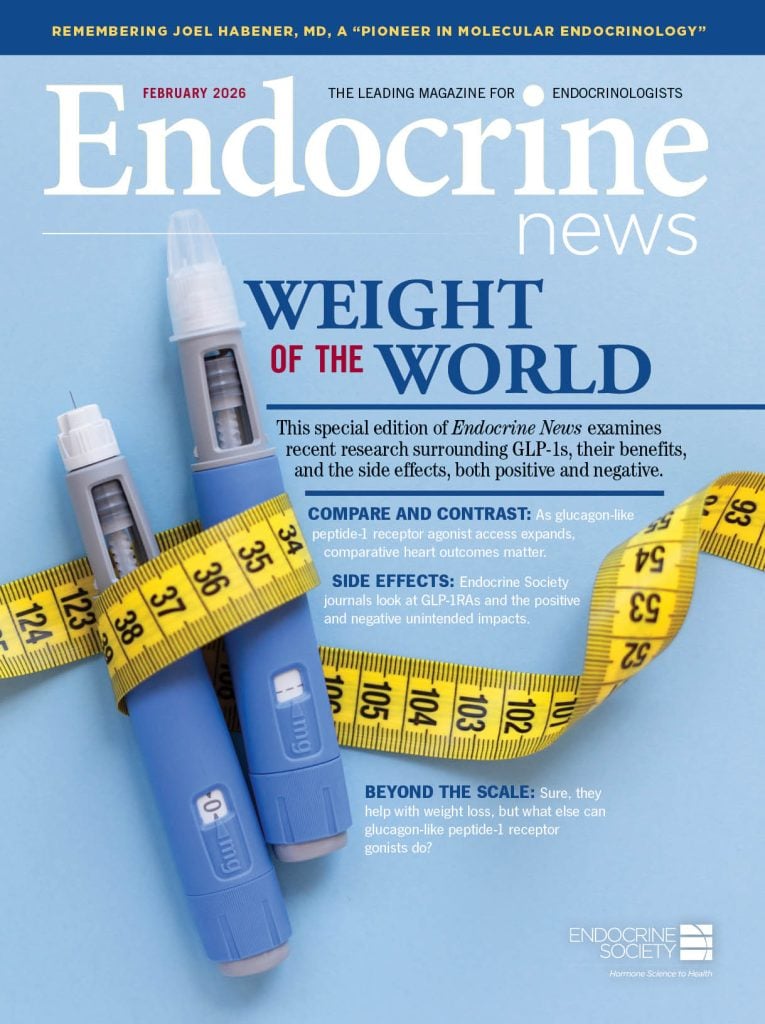
As the use of glucagon-like peptide-1 receptor agonists (GLP-1RAs) expands, so too does our knowledge of just what all these medications can do. GLP-1RAs have now been shown to reduce consumption of alcohol and drugs, even treating addictions to gambling and sex, but these medications can also potentially lead to rare but fatal complications of which endocrinologists should be aware.
Glucagon-like peptide-1 receptor agonists (GLP-1RAs) are certainly making a lot of headlines these days. They’ve been around for decades, helping treat patients with type 2 diabetes and short bowel syndrome, but when it was discovered that they could also help patients with obesity, they became several household names – Ozempic, Wegovy, Mounjaro, etc.
Until a couple months ago, these medications were only available as injectables, which discouraged some patients; yet about 12% of U.S. adults reported taking GLP-1RAs for weight loss, diabetes, or another chronic condition, according to a November 2025 KFF Health Track poll. Now that Novo Nordisk’s Wegovy has been approved in pill form, a recent Sunlight.com Survey suggests that number may jump to 40% in 2026.
As these drugs soar in popularity, researchers and physicians are finding uses form them outside the realm of obesity and diabetes. Clinicians have reported using GLP-1RAs to short-circuit addictions to gambling and sex. A paper recently published in the Journal of the Endocrine Society (JES) even describes how GLP-1RAs might be used to treat alcohol and drug addictions.
GLP-1s and Addiction
The authors of “GLP-1 Therapeutics and Their Emerging Role in Alcohol and Substance Use Disorders: An Endocrinology Primer,” appearing in October 2025 in JES, point out that the World Health Organization reported 890 million adults and 60 million children and adolescents had obesity in 2022 globally. They go on to connect obesity and addiction. They admit that can be controversial, but they write that obesity may have phenotypic characteristics that resemble addiction, including neurocircuitry mechanisms. “Pathways implicated in addiction also contribute to pathological overeating and obesity,” they write.
“Clinical research also shows that some neuroimaging features observed in people with obesity resemble those seen in people with addiction,” says Lorenzo Leggio, MD, PhD, clinical director of the National Institute on Drug Abuse and corresponding author of the JES paper. “Finally, in clinical practice, some medications used to treat addiction can also affect appetite and body weight. Taken together, evidence from neuroscience, human research, and clinical practice suggests meaningful overlap between obesity and addiction-related mechanisms.”
Leggio says that his lab has long been interested in how gut-brain neuroendocrine pathways may influence alcohol use disorder (AUD). “Our overarching framework is that gut–brain (and other periphery-to-brain) endocrine signaling may play a role in AUD (and potentially other substance use disorders) and could therefore represent novel targets for treatment development. With that in mind, we have studied pathways involving insulin, ghrelin, and GLP-1,” he says.
“Clinical research also shows that some neuroimaging features observed in people with obesity resemble those seen in people with addiction. Finally, in clinical practice, some medications used to treat addiction can also affect appetite and body weight. Taken together, evidence from neuroscience, human research, and clinical practice suggests meaningful overlap between obesity and addiction-related mechanisms.” – Lorenzo Leggio, MD, PhD, clinical director, National Institute on Drug Abuse, Bethesda, Md.
Current treatments for alcohol and other substance use disorders include behavioral therapy and rehabilitation and a few FDA-approved medications, but the irony is that while these disorders can carry a stigma, so can seeking treatment for them. The authors write that there can be self-stigma or internalized stigma, which can lead to reluctance in seeking treatment.
“We need to expand addiction medicine education in medical school and residency training,” Leggio says. “Alcohol and other substance use disorders are common, and clinicians should be prepared to recognize them, just like hypertension and diabetes. Education alone isn’t the whole solution, but it’s an important part of reducing stigma. And reducing stigma is critical if we want current and future medications for substance use disorders to have their full impact.”
The authors write that the effects of GLP-1RAs on alcohol use have been studied extensively. Preclinical trials in rodents and nonhuman primates show these medications reduce alcohol intake. Humans have shared anecdotal reports about how taking GLP-1RAs for other indications helped them reduce their alcohol consumption as well. “I have heard that from some patients, typically in calls or emails: they have noticed reduced drinking and/or smoking after starting a GLP-1 receptor agonist,” Leggio says. “But these are anecdotal observations, not clinical evidence, and they shouldn’t be taken as a basis for changing treatment without medical guidance.”
Alcohol and other substance use disorders are common, but they remain substantially underdiagnosed and undertreated. Leggio says that it is important to emphasize that these are not “bad behaviors” or “bad habits” but chronic medical conditions, like diabetes, hypertension, or rheumatoid arthritis. “The possibility that GLP-1 receptor agonists may be effective for some substance use disorders is promising, but we need large randomized controlled trials to confirm benefit and clarify for whom they work best,” he says.
Unforeseen Reactions
In February 2025, the paper, “Euglycemic Ketoacidosis Following Coadministration of an SGLT2 Inhibitor and Tirzepatide,” appeared in JCEM Case Reports, describing a patient who was admitted to the intensive care unit after being placed on both medications. Tirzepatide is a novel dual GLP-1 and glucose-dependent insulinotropic polypeptide receptor agonist recently approved for diabetes and weight loss.
The authors write that they suspect the two medications had synergistic effects in the patient, leading to adequate control of his blood sugars yet a state of starvation, ketone production, and resultant systemic acidification. “The patient required treatment and monitoring in an ICU to make a full recovery,” they write. “As tirzepatide is a relatively new medication whose side effect profile has yet to be fully characterized, clinicians should be aware of this rare yet potentially fatal complication.”
“Although GLP-1 receptor agonists show impressive efficacy and favorable side effect profiles, it is necessary that we determine all risks and side effects, particularly rare ones, to minimize chances of poor outcomes,” says the paper’s first author Eli J. Louwagie, MD, PhD, of the Department of Internal Medicine at LewisGale Hospital Montgomery in Blacksburg, Va. “This is especially important considering the increasing use of these medications.”
The authors write that, to their knowledge, this is the first case detailing a patient developing this serious condition after starting tirzepatide for diabetes (in contrast to those treated with tirzepatide for weight loss). Louwagie tells Endocrine News that that he and his co-authors would want clinicians to keep this potential side effect in mind for all patients presenting with signs of ketoacidosis while on tirzepatide.
“There were several factors varying between our patient and the other cases, particularly our patient also taking an SGLT2 inhibitor, but our case may suggest greater risk of EKA for a patient on synergistic regimens,” Louwagie says. “Further studies are needed to investigate this hypothesis, but we suspect recent changes in medication prescribing practices and medication prices will result in large datasets allowing scientists to investigate these potential relationships.”
Christine Rode Schwarz, PhD, of the Steno Diabetes Center in Copenhagen, and her co-authors pointed to this case in a commentary titled, “Mechanism and Context: Making Sense of Adverse Events With GLP-1-based Therapy,” also published in JCEM Case Reports later that year. The authors write that Louwagie’s case report (and others’) should not detract from the substantial value of GLP-1 based therapies, but they do speak yet again to the importance of individualized therapy.
“Although clinical, empirical data guides medical practice, every patient is unique and deserves individualized considerations. Many patients are on a combination of an SGLT2 inhibitor with a GLP-1 receptor agonist or tirzepatide (a dual agonist) and have incredible success without adverse reactions, but we are still figuring out the patient characteristics that would put them at higher risk of poor outcomes.” – Eli J. Louwagie, MD, PhD, Department of Internal Medicine, LewisGale Hospital Montgomery, Blacksburg, Va.
Schwarz says the commentary is a call for disciplined use, not a warning against the class of medications. “GLP-1–based therapies deliver major benefits for glycemia, weight, and in some settings cardiovascular risk,” she says. “Most adverse events reflect expected pharmacology interacting with patient context. When prescribing is supervised and thoughtful, these medicines are effective and safe.”
Louwagie agrees that the case report highlights the need for individualized care. “Although clinical, empirical data guides medical practice, every patient is unique and deserves individualized considerations,” he says. “Many patients are on a combination of an SGLT2 inhibitor with a GLP-1 receptor agonist or tirzepatide (a dual agonist) and have incredible success without adverse reactions, but we are still figuring out the patient characteristics that would put them at higher risk of poor outcomes.”
Bagley is the senior editor of Endocrine News. In the January issue he wrote about the connection between the thyroid and cardiac health.

 Loading ...