


Obviously, from that headline I’m referring to GLP-1s and their many similar glucagon-like peptide-1 receptor agonist cohorts that have become a medical, healthcare, and even cultural zeitgeist over the course of the last couple of years. In fact, I bet every single person reading these words can sing the Ozempic jingle right now!
This month’s issue features a wealth of information on the studies that are spilling out of every peer-reviewed journal you can think of. Truly, an embarrassment of riches, and yet we barely scratched the surface with what we discuss on the following pages as more and more studies are released every day. So, while no means an exhaustive list – and if you check this month’s Endocrine Society journals, you’ll see even more recently released research! – but it’s what we had to work with at the time of planning this issue.
Kelly Horvath looks at the cardiac outcomes in patients taking these obesity conquering drugs in “Compare and Contrast.” Specifically, she talks to the researchers about their recent studies to get more insights into how this new class of pharmaceuticals could affect the user’s cardiac health. “It is important to understand whether the cardiovascular benefits of GLP-1RAs are limited to those who also experience glycemic and/or weight benefits, or we see benefits in hard outcomes more broadly,” according to Rozalina G. McCoy, MD, MS, from the University of Maryland School of Public Health THRIVE (Transforming Health through Real-world Insights, Values, and Evidence) Lab, in Baltimore, Md., and Stacey M. Sklepinski, MD, from the Advocate Lutheran General Hospital, Park Ridge, Ill. “Current indirect evidence from the cardiovascular outcomes trials suggests that cardiovascular benefits are at least partly independent of glucose-lowering, but the same analysis was not done for weight loss.”
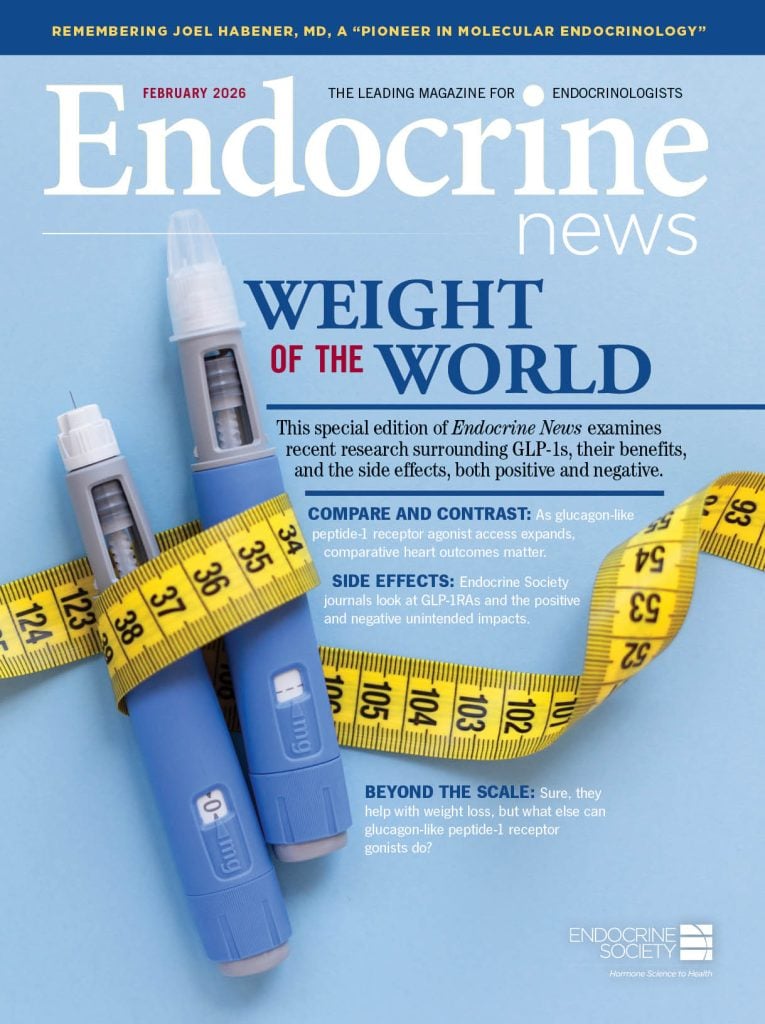
In “Beyond the Scale: What Else Glucagon-like Peptide-1 Receptor Agonists Can Do,” Kelly takes a look at a variety of journal studies that examine the impact of incretin-based therapies on cardiovascular health, as well as how they affect the liver, quality of life, insulin resistance, and much more. According to Ambarish Pandey, MD, MSCS, from the University of Texas Southwestern Medical Center in Dallas, clinicians shouldn’t hesitate to administer semaglutide because a patient with obesity-related heart failure with preserved ejection fraction (HFpEF) looks too frail. “They’re the ones who stand to benefit most,” he explains. “In our analysis, the frailest patients saw the largest symptom gains, were far more likely to improve their frailty status, and experienced fewer serious adverse events on semaglutide than on placebo. If you’ve been hesitant because a patient seems fragile, reconsider. That’s exactly who should be getting this therapy.”
Endocrine News Senior Editor Derek Bagley takes a look at some recent studies published in Endocrine Society journals in “Side Effects” that examine both the positive and negative unintended impacts of GLP-1RAs. On the positive side, GLP-1RAs have apparently been shown to reduce consumption of alcohol and drugs as well as curtailing addictions to sex and gambling. However, there are cases of fatal, albeit rare, complications that endocrinologists need to be aware of. “Although GLP-1 receptor agonists show impressive efficacy and favorable side effect profiles, it is necessary that we determine all risks and side effects, particularly rare ones, to minimize chances of poor outcomes,” says Endocrine Society member Eli J. Louwagie, MD, PhD, of the Department of Internal Medicine at LewisGale Hospital Montgomery in Blacksburg, Va., and one of the authors of a study discussed. “This is especially important considering the increasing use of these medications.”
Derek has also written a tribute to the life and career of Joel Habener, MD. Habener died in December at the age of 88, but he left behind a legacy that has certainly led to where we are today in terms of these GLP-1s and many other obesity-fighting drugs. According to Daniel J. Drucker, MD, senior investigator, Lunenfeld-Tanenbaum Research Institute, Sinai Health; professor, Department of Medicine, University of Toronto’s Temerty Faculty of Medicine, Ontario, Canada, and a former member of Habener’s lab, Habener will be “remembered as a visionary scientist whose discoveries transformed the field of metabolic medicine and as a highly sought after mentor who trained generations of independent investigators.”
Until next month, if you have any story ideas that you think Endocrine Society members would be interested in, feel free to drop me a line at: [email protected].

 Loading ...