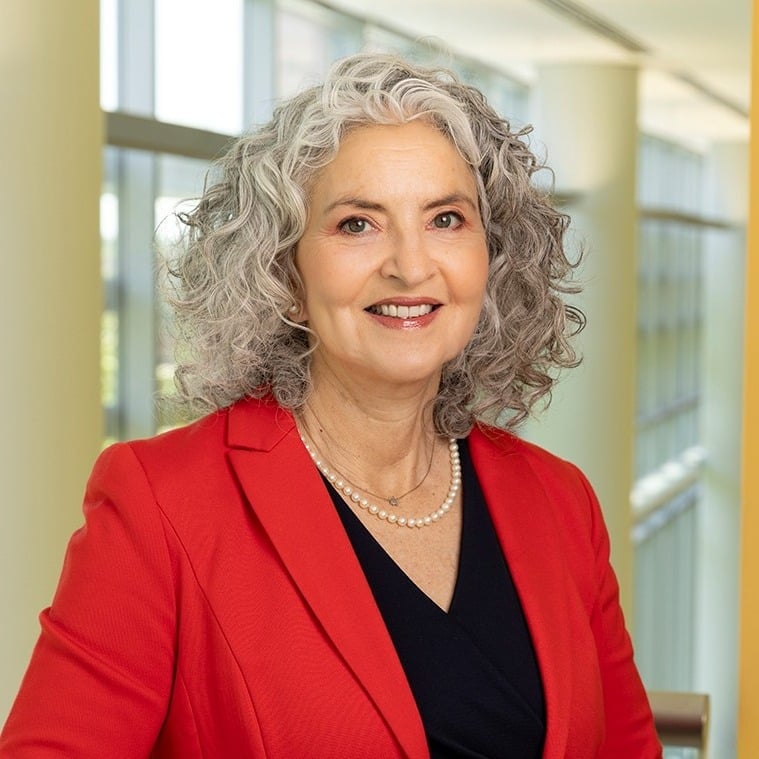
Nanette Santoro, MD, knew she wanted to be a doctor at age 16, feeling like it was the best way to help people, something that would be good for mankind.
The Endocrine Society is pleased to welcome Santoro, of the University of Colorado School of Medicine in Aurora, Colo., as its 2026 – 2027 president. She will take office in June 2026 at ENDO in Chicago, succeeding Carol Lange, PhD.
Santoro has served as E. Stewart Taylor Chair of Obstetrics & Gynecology at the University of Colorado School of Medicine since 2010. She is a well-recognized practitioner, dedicated mentor and leading researcher on studies of women with premature and age-appropriate menopause.
She has held many roles with the Endocrine Society, including serving as vice president of clinical science, an author on two women’s reproductive health Clinical Practice Guidelines and chair of the Society’s Scientific Statement on bioidentical hormones. She also won the Society’s 2016 Laureate Award for Outstanding Mentorship.
“The Endocrine Society was the first society I joined as a fellow,” Santoro says. “This is really a highlight for me.”
“The Greatest Field”
Santoro originally thought she wanted to be a writer; she won the Joyce Carol Oates Award in high school for a short story but enrolled in a six-year medical program out of high school. Since she would be a first-generation college graduate in her family, she thought if she could almost fast-track her education, it would be less of a financial burden on her loved ones.
“I loved writing, so I applied to the six-year program, and I decided I was going to try to become a professional writer and a novelist, or I was going to be a doctor,” Santoro says. “If I didn’t get into medical school, then I was just going to go into writing.”
“I foresee a lot of advocacy that’s really necessary to keep endocrinology in the game here, to make its presence known how important endocrine conditions are, and how it touches on so many areas of science that it’s really critical that their voice is heard.”
Santoro was accepted to the six-year BS/MD program at Rensselaer Polytechnic Institute and Albany Medical College, where she developed an interest in endocrinology. She completed her residency at Beth Israel Medical Center, where she met one of her role models, Nelly Szlachter, who was a reproductive endocrinologist. [Szlachter] had done her training at NYU and told Santoro, “[Reproductive endocrinology] is the greatest field.”
From there she got a fellowship at Massachusetts General Hospital, working in the Reproductive Endocrine Unit and she admits she didn’t know much about biomedical science or the whole research enterprise, because she had only had a brief introduction to those fields in medical school.
“It was an incredibly exciting time to be there because stuff was just happening left and right,” Santoro tells Endocrine News. “The science was fantastic. It was all new, exciting knowledge. Once the pulsatile nature of GnRH secretion was established, all of these applications just kind of fell out of that work and it was a matter of just doing it, learning from it, and then going on to the next problem.”
A Big Finding
Santoro says she also belongs to the Menopause Society and the American Society for Reproductive Medicine, but the Endocrine Society is her first home. “It’s the best forum for the kind of research that I do,” she says. “I will often save my best work where I need the most feedback from the smartest people for the Endocrine Society. If I have really gnarly endocrine problem, it’s coming to ENDO.”
One of those problems to solve was that perimenopausal women. With help from colleagues, Santoro did urinary assays to do daily sampling of women. “I wanted to look at premature menopause,” she says. “That was the problem I decided I was going to take with me from the Reproductive Endocrine Unit. “
Santoro says that Robert W. Rebar, MD, former executive director of the American Society for Reproductive Medicine, had advised her to analyze data from perimenopausal women, and when Santoro and her colleagues looked at hormone levels, they were all over the place – some way up, some way down. “I said, ‘I’ve never seen anything like this. We’ve been doing normal menstrual cycles for years at Mass General. What is this? Repeat them all,’” she says.
So, they repeated the tests. A few times, actually. Santoro knew she was on to something. She says: “I went home the day I saw that data and I said to my husband, ‘I think this is a big deal. I think this is a big finding. That’s going to really influence what I do and how I think.’ Just seeing those erratic patterns that had really just only intermittently been reported before was something that I really seized on and that led to a lot of other things.”
Pointing the Way
Santoro says that another one of the highlights of her career has been mentoring, just as she was mentored. She gives the example of Rebecca Thurston, PhD, a former president of Menopause Society. Thurston’s background is in epidemiology and psychology, but she had career development award from the National Institutes of Health (K award) and asked Santoro to teach her about hormones.
In fact, Santoro is mentoring junior-level faculty from other specialties – psychology, epidemiology, physiology – at institutions across the United States, meeting over Zoom to discuss hormones and funding opportunities. “I’m also a mentor for Building Interdisciplinary Research Careers in Women’s Health (BIRCWH), a NIH K12-funded career development program,” Santoro says. “That’s another venue where I can mentor junior faculty along research lines.”
“Even though a lot of the change seems adverse, there’s always opportunity. We need to find that, and we need to open up the window because we need to show people that this is a field that really is vital. It’s fascinating. It’s so important in people’s lives, and there’s a lot of good that can be done.”
“As a fellow,” she continues, “you’re mentoring at a very granular level, teaching people the details. One of the most challenging groups that I mentor are my general OBGYNs because it takes you 30 years to become really an expert when you’re really covering the entire field. That’s the opposite of my own career path, which was I really wanted to drill down onto something small and learn as much as humanly possible about that.”
Change and Opportunity
Santoro takes the helm of the Endocrine Society in turbulent times, and she’s very aware of that fact. “I foresee a lot of advocacy that’s really necessary to keep endocrinology in the game here, to make its presence known how important endocrine conditions are, and how it touches on so many areas of science that it’s really critical that their voice is heard,” she says. Santoro is also aware of the clog in the endocrinology pipeline, saying it needs to be revitalized, especially in this time of change. “Even though a lot of the change seems adverse, there’s always opportunity,” she says. “We need to find that, and we need to open up the window because we need to show people that this is a field that really is vital. It’s fascinating. It’s so important in people’s lives, and there’s a lot of good that can be done.”