

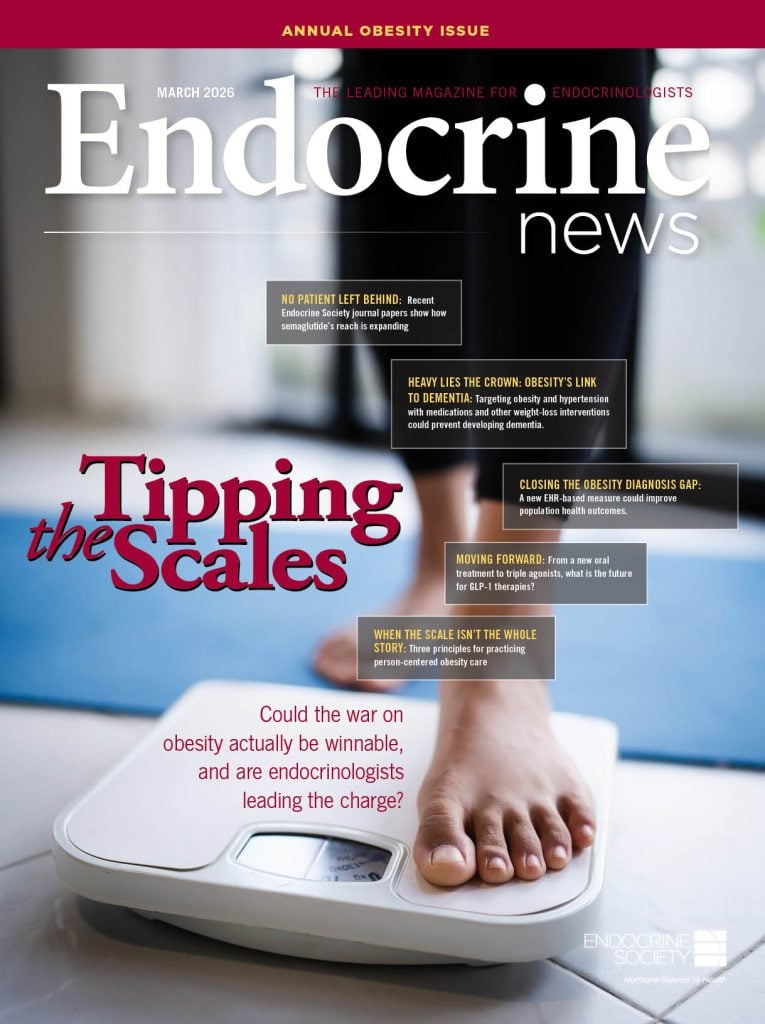
A recent JCEM paper has indicted obesity as the possible cause of yet another disease – vascular-related dementia. Targeting obesity and hypertension with medications and other weight-loss interventions could prevent developing dementia.
In a 2007 paper published in Obesity Reviews, the late Sir David Haslam wrote that the origins of obesity can be traced back 30,000 years. In the paper, “Obesity: a medical history,” Haslam explains that humans who could store energy in the most efficient way would survive inevitable fasts and famine.
“But natural selection has turned on us,” Haslam writes. “Life now favours inefficient phenotypes who fail to store energy in adipose depots, while those who lay down fat in the abdomen are condemned to premature death. To fight obesity, we are flying in the face of evolution and instinct, consciously countermanding the urge to eat for survival, and be as inactive as possible in order to conserve energy.”
Obesity has had a complicated history these past 30,000 years. In some cultures, obesity was viewed as something to attain. Now, many still view it as simply a lack of willpower. The ancient Greeks recognized obesity as a disease. Hippocrates wrote that not only is obesity a disease itself, “but the harbinger of others.”
Obesity is linked to more than 200 diseases – type 2 diabetes, cardiovascular disease, cancer. And now, new research published in The Journal of Clinical Endocrinology & Metabolism suggests that people with obesity and hypertension may be at a higher risk of dementia.
Establishing Causality
The authors of the January 2026 paper, “High Body Mass Index as a Causal Risk Factor for Vascular-Related Dementia: A Mendelian Randomization Study,” by Nordestgaard et al, point out that the relationship between obesity and dementia has been debated for decades with conflicting results from a range of case-control and prospective studies. “An important finding was, however, that midlife obesity but not late-life obesity was associated with risk of dementia,” the authors write.
The authors go on to write that recent meta-analyses and reviews have shown that antihypertensive, cholesterol-lowering, and antidiabetic medications have documented lower risk of dementia in treated individuals. The researchers set out whether body mass index (BMI) might cause vascular-related dementia. A randomized controlled trial would be the best way to establish or reject causality, according to the authors, but randomized controlled trials are expensive and difficult, especially when including subjects with dementia.
The researchers analyzed data from hundreds of thousands of participants in Copenhagen and the U.K. and identified a causal link between higher body weight and dementia.
The researchers were able to establish a direct causal link between high BMI and dementia because they used a so-called Mendelian randomization design that mimics a randomized controlled trial. In the Mendelian randomization study design, common genetic variants causing high BMI are used as proxies for BMI-altering medications.
As active drug versus placebo is randomly assigned due to the randomization process in drug trials, and as BMI-increasing genetic variants versus neutral variants are randomly assorted from parents to offspring, the effects on the disease endpoint will be clear and not affected by confounding factors.
Therefore, this strategy enabled the researchers to establish a direct causal link between high BMI and risk of dementia. Much of this increased dementia risk appeared to be driven by high blood pressure, suggesting that preventing or treating obesity and high blood pressure could help reduce dementia risk.
“In this study, we found high body mass index (BMI) and high blood pressure are direct causes of dementia,” says study corresponding author Ruth Frikke-Schmidt, MD, PhD, professor and chief physician at Copenhagen University Hospital – Rigshospitalet and the University of Copenhagen in Copenhagen, Denmark. “The treatment and prevention of elevated BMI and high blood pressure represent an unexploited opportunity for dementia prevention.”
“Unexploited Opportunity”
In the Discussion section of the JCEM paper, the authors write that obesity affects more than 600 million people globally, while more than 50 million people worldwide suffer from dementia, and both numbers are growing. “Treatment and prevention options for dementia are scarce,” the authors write, “underscoring the need to identify causal modifiable risk factors, as demonstrated here for risk of vascular-related dementia by high BMI mediated via high blood pressure.”
This paper raised a few questions. For example, while many studies have shown that a BMI over 30 is associated with a higher risk of vascular dementia, it’s been reported that a BMI below 18.5 also carries a higher risk of dementia. “However, this latter association is likely to be a result of reverse causation, since the prodromal phases of dementia are accompanied by loss of appetite and weight loss,” the authors write.
“An open question that remains to be tested is if weight-loss medication initiated before the appearance of cognitive symptoms may be protective against dementia. Our present data would suggest that early weight-loss interventions would prevent dementia, and especially vascular-related dementia.” — Ruth Frikke-Schmidt, MD, PhD, professor and chief physician, Copenhagen University Hospital – Rigshospitalet; University of Copenhagen, Copenhagen, Denmark
Studies have shown that antihypertensive and weight-loss medications are associated with a lower risk of developing Alzheimer’s, and while there are ongoing clinical trials of the effect of semaglutide on the risk of dementia, they haven’t shown much promise yet. Last November, Novo Nordisk released topline results of their phase Evoke trial of semaglutide in people with Alzheimer’s, but the trial did not meet its primary endpoint.
The authors of the JCEM paper remain hopeful though, writing, “The presently observed positive linear relationship between BMI and risk of IHD is well established and serves as a positive control for our study.”
“In conclusion,” the authors write, “we find that high BMI is likely to be on the causal pathway to vascular-related dementia, and that a substantial fraction of this risk is mediated through high blood pressure. This is important, as the treatment and prevention of elevated BMI and high blood pressure represent an unexploited opportunity for dementia prevention in the clinic.”
“This study shows that high body weight and high blood pressure are not just warning signs, but direct causes of dementia,” Frikke-Schmidt says. “That makes them highly actionable targets for prevention.”
“Weight-loss medication has recently been tested for halting cognitive decline in early phases of Alzheimer’s disease, but with no beneficial effect,” she continues. “An open question that remains to be tested is if weight-loss medication initiated before the appearance of cognitive symptoms may be protective against dementia. Our present data would suggest that early weight-loss interventions would prevent dementia, and especially vascular-related dementia.”
Bagley is the senior editor of Endocrine News. In the February issue, he wrote about the positive and negative unintended impacts of GLP-1 RAs.

 Loading ...