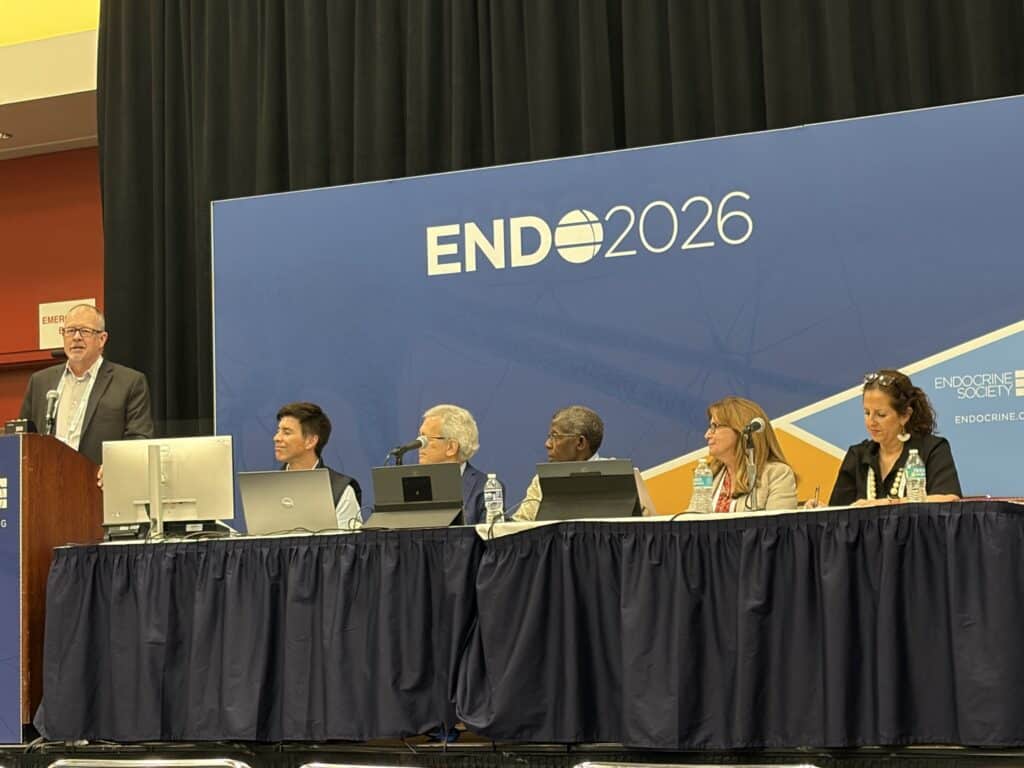

Endocrine Society member Daniel J. Drucker, MD, (pictured above, left, with 2025 – 2026 Endocrine Society President Carol Lange, PhD, at ENDO 2026 in Chicago in June) and Jens Juul Holst, MD, DMSc, have been honored with the 2026 Lefoulon-Delalande Foundation Scientific Prize from the Institut de France for their work on GLP-1s, a key hormone in metabolic regulation.
Each year, the Lefoulon-Delalande Foundation awards its Scientific Prize to a scientist who has made a major contribution to cardiovascular physiology, biology, or medicine. In 2026, the Scientific Prize, endowed with €600,000, will be shared equally between two laureates and their laboratories.
The scientific council awarded the 2026 Lefoulon-Delalande Foundation Scientific Prize to the duo by majority decision.
GLP-1 plays a crucial role in the regulation of metabolic balance, particularly in the control of blood glucose levels and in the pathophysiology of diseases such as type 2 diabetes, obesity, inflammation, and cardiovascular diseases. The therapeutic development of GLP-1 agonists has had a major impact on the management of these conditions and, more broadly, on human health.
Drucker, the 2025 recipient of the Endocrine Society’s Fred Conrad Koch Lifetime Achievement Award, is a professor of medicine at the Lunenfeld Tanenbaum Research Institute of Mt. Sinai Hospital and the University of Toronto in Toronto, Canada. In 2020, Drucker also received the Endocrine Society’s John D. Baxter Prize for Entrepreneurship for his contributions to diabetes treatment.
Known for his discovery of glucagon-like peptide-1 (GLP-1) action in the 1980s as a research fellow with Joel Habener, MD, at Massachusetts General Hospital, Drucker identified a truncated form of GLP-1 as the biologically active form and demonstrated that this shorter version of GLP-1 stimulates secretion of insulin in a glucose-dependent manner in in pancreatic beta cells.
These foundational studies supported the development of new classes of GLP-1 medications for type 2 diabetes and obesity. Drucker’s observations that GLP-1 has a protective effect on the heart, reducing heart damage from myocardial infarction and lowering inflammation, independent of changes in blood glucose or body weight, have been validated in clinical trials and in the real world. GLP-1 medicines lower rates of heart attacks, strokes, heart failure and overall cardiovascular mortality. More importantly. these benefits stem partly from a reduction in inflammation – confirming Drucker’s original findings in mice.
Drucker was the first to characterize GLP-1 receptor expression in immune cells, identifying a relatively small population of immune T cells in the gut as GLP-1 receptor-positive and important for T cell driven inflammation. More recently Drucker demonstrated that GLP-1 acts on GLP-1 receptor-positive neurons
in the brain, to produce systemic anti-inflammatory effects in peripheral organs. His recent cardiovascular studies have demonstrated the importance of vascular smooth muscle cell GLP-1 receptors for the control of blood pressure, and of liver sinusoidal endothelial GLP-1R+ cells for the control of liver inflammation and fibrosis.
Collectively, his basic science discoveries have yielded multiple insights into the efficacy and safety of an expanding class of GLP-1 medicines with major benefits for human health.
Drucker received training in internal medicine and endocrinology from the Johns Hopkins Hospital in Baltimore and the University of Toronto, followed by a fellowship in molecular endocrinology at Massachusetts General Hospital. His discoveries have enabled development of several new GLP-1-based therapies for the treatment of diabetes and obesity and GLP-2 analogues for intestinal failure. His basic science studies have elucidated multiple novel mechanisms of GLP-1 action underlying the cardiovascular benefits of GLP-1 medicines.
Drucker has received numerous international awards for his translational science and has been elected to the Order of Canada, the Canadian Medical Hall of Fame, Fellowship in the Royal Society (London) and the National Academy of Sciences and National Academy of Medicine.