

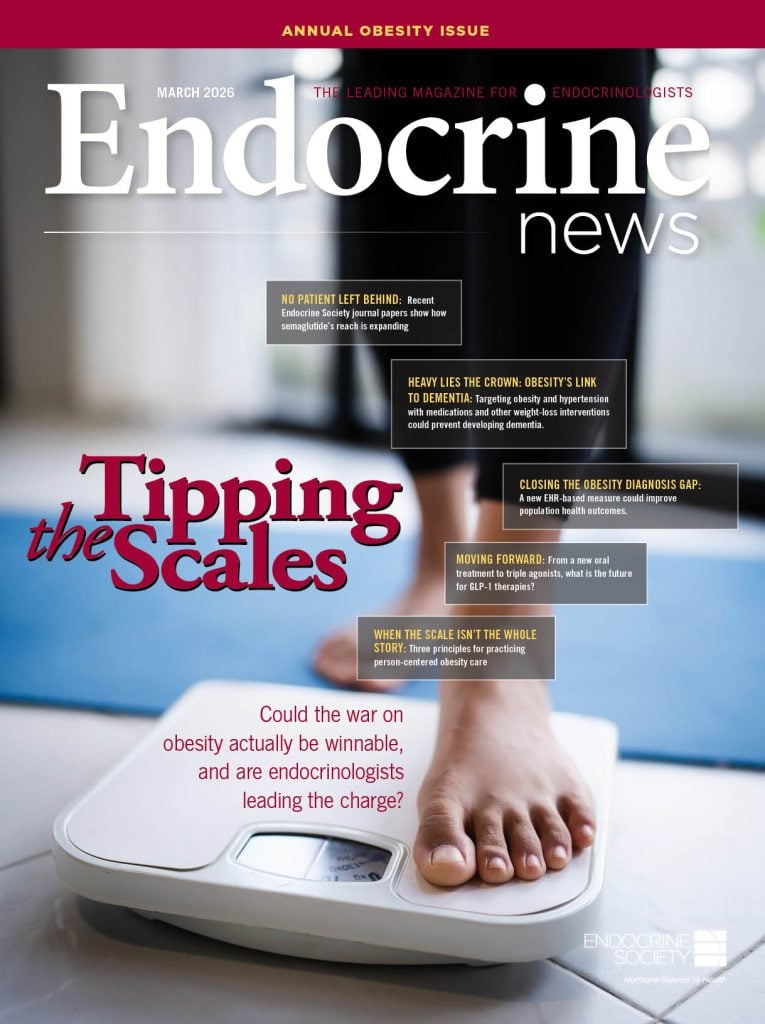
Once again, Endocrine News is devoting an issue to the obesity epidemic, but this year things don’t look as dire as they have in past years. Yes, overweight and obesity is still running rampant around the world. That’s the bad news. The good news is that with the help of the spate of new pharmaceuticals, things are definitely getting better.
When the Endocrine Society held a science writers conference dedicated to the current landscape and future horizons of GLP-1 therapies, Endocrine News Senior Editor Derek Bagley was in attendance and wrote about the presentations in “Moving Forward: The Future of GLP-1 Therapies.” He caught up with the two experts who spoke at the conference — Priya Jaisinghani, MD, DABOM, and Mehmet Furkan Burak, MD — to learn what’s next for these medications and what they mean for people with obesity. According to Jaisinghani, a clinical assistant professor from NYU Langone in New York, these medications do much more than simply improve the number on the scale. “They have improved insulin resistance, blood pressure, lipids, inflammatory markers, knee osteoarthritis, and have gained indications for glycemic control, fatty liver disease, cardiovascular risk, chronic kidney disease in those living with type 2 diabetes. That’s why calling them ‘weight loss meds’ undersells what they actually do.”

Derek explores another aspect of obesity that was published recently in The Journal of Clinical Endocrinology & Metabolism that linked this problematic condition to yet another comorbidity: vascular-related dementia. In “Heavy Wears the Crown: Obesity’s Link to Dementia,” Derek takes a deeper dive into the paper, “High Body Mass Index as a Causal Risk Factor for Vascular-Related Dementia: A Mendelian Randomization Study,” that posits that targeting obesity and hypertension with various pharmacological treatments might actually prevent dementia from developing in some patient populations. “In this study, we found high body mass index (BMI) and high blood pressure are direct causes of dementia,” according to Ruth Frikke-Schmidt, MD, PhD, professor and chief physician at Copenhagen University Hospital – Rigshospitalet and the University of Copenhagen in Copenhagen, Denmark, and the study’s corresponding author. “The treatment and prevention of elevated BMI and high blood pressure represent an unexploited opportunity for dementia prevention.”
More Endocrine Society journal research is highlighted by Kelly Horvath for “No Patient Left Behind: Expanding Semaglutide’s Reach.” demonstrates how GLP-1 RAs, well known and rightly praised for reducing obesity, are also showing some surprising results regarding a variety of other conditions. Studies from JCEM, JCEM Case Reports, and The Journal of the Endocrine Society are well represented here as Kelly discusses studies that run the gamut of topics: improving taste sensitivity in patients, positive results in a pediatric patient with various comorbidities, and even being effective treatments for patients with a variety of psychiatric disorders, these drugs are continuing to go “above and beyond.”
Maureen Corrigan, MA, the Endocrine Society’s director of evidence-based practice, discusses a new obesity measure that could potentially make a real difference in managing the disease. In “Closing the Obesity Diagnosis Gap: A New EHR-Based Measure Could Improve Population Health Outcomes,” she delves into a recent Journal of Clinical Endocrinology & Metabolism paper that posits that documenting obesity in electronic health records for those patients who meet the body mass index criteria, regardless of clinical specialty. “At the population level, the lack of consistent documentation limits the ability of health systems to measure quality of obesity care, track outcomes, or identify disparities in recognition and treatment,” Maureen writes. “Additionally, whereas failing to provide a diagnosis of obesity can reinforce bias, official acknowledgement of it as a chronic disease can reduce weight stigma.”
In “When the Scale Isn’t the Whole Story: Three Principles for Practicing Person-Centered Obesity Care,” Endocrine Society member Zeb I. Saeed, MD, shares with clinicians three patient-centered principles for treating overweight and/or obesity. According to Saeed, years of societal messaging has led many people to believe that weight is purely a matter of willpower, discipline, or personal failure. “One of the most powerful things we can do as weight management clinicians is to help our patient unlearn this narrative,” she writes. “We now understand that obesity, just like any other chronic medical condition, is strongly influenced by genetics, epigenetics, neurohormonal regulation, and environmental factors.” She adds that as endocrinologists taking care of people living with overweight and obesity, “we all have the unique opportunity and responsibility to shape how obesity care is delivered for years to come,” both individually and on a larger, society-wide level.
As you can see, Endocrine News and the Endocrine Society are both focused on doing our part to conquer the worldwide epidemic of obesity. Feel free to reach out to me if you have any future story ideas on obesity-related topics or other topics that would be of interest to our readers. You can reach me at: [email protected].

 Loading ...